
Introduction
The digital marketing industry is changing rapidly, and artificial intelligence is becoming part of almost every marketing workflow. From content creation and SEO research to paid advertising, analytics, and automation, marketers now have access to hundreds of AI-powered tools.
But having access to more tools does not automatically make someone a better marketer.
Many beginners spend weeks experimenting with ChatGPT, Claude, Gemini, Perplexity, and other AI platforms without developing a clear understanding of how these tools fit into an actual marketing workflow. They learn individual features but struggle to apply them to real business problems.
The result is often a collection of disconnected tools rather than a useful professional skill set.
The better approach is to build a structured AI marketing skill stack. This means learning the marketing fundamentals first, understanding which AI tools support each function, and developing the ability to connect those tools into practical workflows.
For students, fresh graduates, and digital marketing professionals, this approach creates a stronger foundation for learning AI-powered marketing without getting distracted by every new tool release.
What Is an AI Marketing Skill Stack?
An AI marketing skill stack is a combination of marketing knowledge, technical skills, AI tools, and practical workflows that help marketers plan, execute, measure, and improve campaigns.
Instead of learning AI tools randomly, marketers organize their learning around specific business functions.
For example:
| Marketing Function | Skills to Learn | Relevant AI Tools |
| Content Marketing | Research, writing, editing | ChatGPT, Claude |
| SEO | Keyword research, search intent, optimization | ChatGPT, Gemini, Perplexity |
| Paid Advertising | Campaign planning, ad copy, testing | ChatGPT, Gemini |
| Analytics | Data interpretation, reporting | ChatGPT, Microsoft Copilot |
| Automation | Workflow design, integrations | n8n, Make |
| Research | Competitor and market analysis | Perplexity, Claude |
| Marketing Operations | CRM, lead management, reporting | AI Agents, n8n |
The purpose is not to master every tool. It is to understand which tool solves which problem, how to use it effectively, and how to evaluate the output.
Why Learning Random AI Tools Is a Problem
1. You Learn Features Instead of Skills
A tool may have dozens of features, but knowing how to use those features does not necessarily mean you understand marketing.
For example, someone may know how to generate a blog using ChatGPT but still struggle to identify the target audience, understand search intent, or create a content strategy.
The missing skill is marketing knowledge, not another AI tool.
2. You Keep Switching Between Platforms
New AI tools appear constantly. If you try to learn every platform, your attention gets divided.
One week you may focus on ChatGPT. The next week, you switch to Claude. Then you discover another AI writing platform and start over.
This creates a cycle of tool exploration without meaningful progress.
3. You Cannot Build Complete Workflows
Real marketing tasks usually involve multiple stages.
Creating a successful SEO campaign, for example, requires:
Research → Keyword Selection → Content Planning → Writing → Optimization → Publishing → Performance Tracking
Knowing one AI tool is not enough to manage this entire process.
4. You May Produce Content Without Understanding Quality
AI can generate content quickly, but speed does not guarantee accuracy, originality, or business value.
Marketers still need to check:
- Whether the information is accurate
- Whether the content matches search intent
- Whether the message fits the audience
- Whether the content supports business goals
- Whether the final output meets brand standards
A structured learning approach teaches you to use AI as a productivity tool rather than treating it as a replacement for marketing judgment.
The Difference Between Learning AI Tools and Building AI Marketing Skills
Consider two beginners.
Beginner A knows how to use ChatGPT, Claude, Gemini, and several other AI tools. However, they have limited knowledge of SEO, advertising, analytics, and marketing strategy.
Beginner B knows how to conduct keyword research, create campaign plans, analyze performance, and build basic marketing workflows. They use ChatGPT and other AI tools to improve these tasks.
Beginner A may know more software.
Beginner B has a stronger marketing skill set.
For a career in digital marketing, the second approach is more useful because employers need people who can solve marketing problems, not simply operate AI interfaces.
The Structured AI Marketing Skill Stack
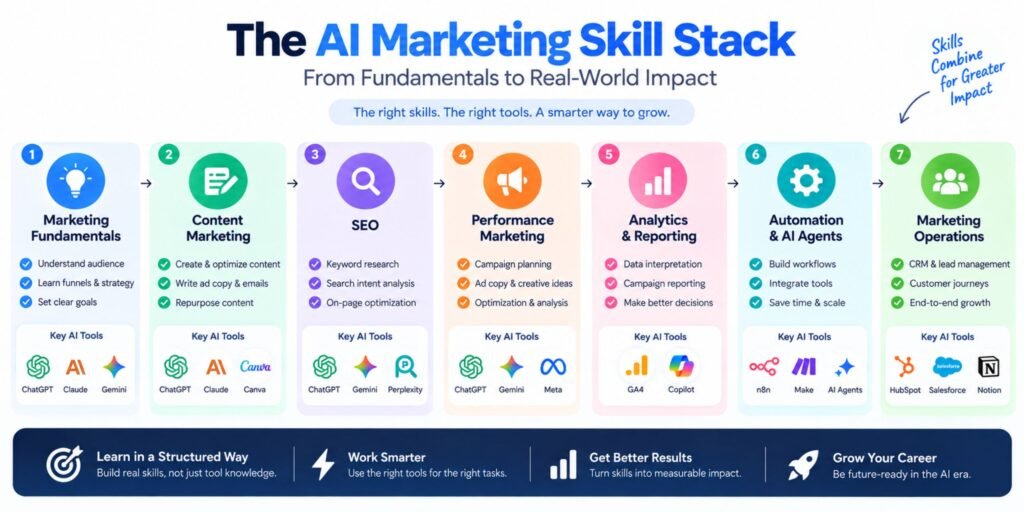
A practical AI marketing skill stack can be organized into six connected layers.
Layer 1: Marketing Fundamentals
Before learning advanced AI tools, understand the basics of digital marketing.
This includes:
- Target audience
- Customer journey
- Marketing funnels
- Search intent
- Content strategy
- Conversion goals
- Brand positioning
- Campaign objectives
AI tools can help explain these concepts and generate examples, but you need to understand the principles yourself.
For example, ChatGPT can help you develop customer personas, but you still need to determine whether those personas accurately represent the business’s target audience.
Recommended AI tools: ChatGPT, Claude, Gemini.
Layer 2: AI-Powered Content Marketing
Content creation is one of the most common applications of AI in digital marketing.
Marketers use AI to support:
- Blog planning
- Social media content
- Email marketing
- Ad copy
- Video scripts
- Content repurposing
- Headline development
ChatGPT
ChatGPT can help generate content ideas, create outlines, draft marketing copy, and adapt content for different audiences.
Claude
Claude is useful for long-form writing, content review, and developing structured marketing documents.
Gemini
Gemini can support content ideation, summarization, and marketing tasks connected to Google’s ecosystem.
Microsoft Copilot
Microsoft Copilot can assist with content drafts, document preparation, and marketing productivity tasks.
The important skill is learning how to create useful prompts, provide relevant context, review the output, and refine it for the intended audience.
Layer 3: AI-Powered SEO
SEO is more than inserting keywords into an article.
A structured AI SEO workflow should include:
Keyword Research → Search Intent → Content Brief → Content Creation → On-Page Optimization → Performance Analysis
AI tools can support each stage.
Keyword Research and Search Intent
Use AI to organize keyword ideas, identify search intent, and develop topic clusters.
For example, a marketer promoting a digital marketing course could use ChatGPT or Perplexity to explore topics related to:
- Digital marketing training
- AI marketing courses
- SEO training
- Google Ads training
- Marketing automation
The output should be reviewed against actual search data and the business’s target audience.
Content Planning
Claude or ChatGPT can help create content briefs with:
- Target keyword
- Search intent
- Suggested headings
- Related questions
- Internal linking opportunities
- Conversion goals
SEO Performance Analysis
Tools such as Google Search Console and GA4 provide actual performance data. AI can help summarize that data and identify areas for further investigation.
Recommended AI tools: ChatGPT, Claude, Gemini, Perplexity.
Layer 4: AI-Powered Performance Marketing
Performance marketing involves measurable outcomes such as leads, sales, registrations, and revenue.
AI can support campaign planning and optimization, but it should be connected to proper tracking and business goals.
A structured performance marketing workflow includes:
Campaign Objective → Audience Research → Ad Creative → Landing Page → Conversion Tracking → Performance Analysis
AI tools can assist with:
- Ad copy variations
- Creative concepts
- Audience research
- Campaign planning
- Landing page messaging
- Performance report summaries
For example, ChatGPT can generate different ad messaging angles, while Gemini can assist with campaign ideas and reporting workflows.
However, AI-generated ad copy does not guarantee better campaign performance. Actual results still depend on the offer, audience, creative quality, landing page, tracking, and budget.
Recommended AI tools: ChatGPT, Gemini, Claude, Microsoft Copilot.
Layer 5: Analytics and Marketing Intelligence
One of the biggest gaps among beginners is the ability to understand marketing data.
AI can help marketers interpret reports, but accurate data collection must come first.
Important skills include:
- Google Analytics 4
- Google Tag Manager
- Conversion tracking
- Campaign attribution
- Traffic analysis
- Landing page performance
- Cost per acquisition
- Return on ad spend
GA4 and GTM
Google Analytics 4 helps marketers understand website traffic and user behavior.
Google Tag Manager helps manage tracking tags and events.
AI tools can support the reporting process by summarizing data, explaining metrics, and helping marketers identify questions to investigate.
Microsoft Copilot
Copilot can assist with spreadsheet analysis, reporting, and organizing marketing data.
ChatGPT
ChatGPT can help explain performance trends, structure reporting templates, and generate questions for deeper analysis.
The goal is to move from simply collecting data to making better marketing decisions.
Layer 6: Marketing Automation and AI Agents
Automation is where separate marketing skills can become connected workflows.
Instead of manually moving information between tools, marketers can use platforms such as n8n and Make to connect systems.
Example: Lead Management Workflow
Lead Form → CRM → AI Qualification → Sales Notification → Follow-Up
A workflow might capture a lead from a website form, send the details to a CRM, use an AI model to classify the inquiry, and notify the sales team.
n8n
n8n allows marketers to connect applications and build automated workflows.
Make
Make helps connect marketing applications and automate repetitive tasks.
AI Agents
AI Agents can support more complex, multi-step workflows, such as preparing campaign reports, categorizing leads, or identifying unusual performance patterns.
However, automation should be designed around a clear process. Automating a poorly defined workflow usually creates more confusion rather than better results.
How to Build Your AI Marketing Skill Stack Step by Step
Step 1: Choose a Marketing Specialization
Start with one area rather than trying to learn everything simultaneously.
You could begin with:
- SEO
- Content Marketing
- Performance Marketing
- Marketing Analytics
- Marketing Automation
Choose a specialization that matches your career goal.
For example, if you want to become an SEO Executive, start with SEO fundamentals and then introduce AI tools into keyword research, content planning, and optimization.
Step 2: Learn the Core Marketing Concepts
Understand the marketing principles behind the tools.
For SEO, learn search intent and on-page optimization.
For paid advertising, learn campaign objectives, audience targeting, and conversion tracking.
For analytics, learn how metrics connect to business outcomes.
Step 3: Select a Small Set of AI Tools
You do not need ten AI tools to begin.
A beginner’s starting stack could include:
- ChatGPT for content and marketing tasks
- Perplexity for research
- Gemini for Google-oriented workflows
- Microsoft Copilot for productivity
- n8n for automation
Learn these tools through actual marketing tasks rather than only watching feature tutorials.
Step 4: Build Practical Workflows
Create small projects that combine marketing knowledge with AI.
Examples:
- Create an SEO content brief using ChatGPT.
- Research competitors using Perplexity.
- Draft ad copy variations using Gemini.
- Analyze a marketing report using Copilot.
- Build a lead notification workflow using n8n.
Each project should have a clear objective and measurable output.
Step 5: Measure Your Results
Do not judge an AI workflow only by how quickly it produces content.
Evaluate:
- Accuracy
- Relevance
- Time saved
- Quality of the final output
- Business usefulness
- Ease of repeating the workflow
For example, if AI helps reduce the time required to prepare a content brief, check whether the brief is actually useful for the writer and SEO team.
Step 6: Expand Only When Necessary
Once you understand the workflow, learn additional tools if they solve a genuine problem.
A new AI tool should improve the process, not simply add another platform to manage.
Example: A Structured AI Workflow for a Digital Marketing Blog
Suppose a business wants to publish a blog about AI-powered performance marketing.
A structured workflow could look like this:
Research
Use Perplexity to explore the topic and identify relevant questions.
Planning
Use ChatGPT to create a content outline based on the target audience and search intent.
Drafting
Use Claude to develop a detailed article.
SEO Review
Use ChatGPT to review headings, keyword placement, and internal linking opportunities.
Visual Content
Use Canva to create a featured banner and supporting infographic.
Publishing
Publish the article on the website and optimize the page for search engines.
Measurement
Use GA4 and Google Search Console to monitor traffic and engagement.
Automation
Use n8n or Make to connect reporting, notifications, and content workflows.
This is more useful than learning five separate AI tools without understanding how they support the same business objective.
Common Mistakes to Avoid
Learning Too Many Tools at Once
Focus on a manageable set of tools and learn them through real tasks.
Ignoring Marketing Fundamentals
AI cannot replace knowledge of customers, campaigns, funnels, and business objectives.
Trusting AI Output Without Verification
Review factual claims, data, recommendations, and generated content before using them professionally.
Automating Everything Immediately
First understand the workflow manually. Then identify which repetitive steps should be automated.
Measuring Productivity Without Quality
Saving time is useful only if the final output remains accurate and effective.
Following Every New AI Trend
Not every new AI tool is relevant to your work. Choose tools based on actual needs.
How IILD’s Training Approach Supports a Structured AI Marketing Skill Stack
A practical AI marketing course should not treat AI as a collection of unrelated software tutorials.
Instead, learners should understand how AI fits into the broader digital marketing process.
IILD’s Digital Marketing AI Course can connect AI tools with practical marketing skills such as:
- SEO
- Content Marketing
- Google Ads
- Meta Ads
- GA4
- Google Tag Manager
- Conversion Tracking
- Marketing Automation
- Data Analytics
- AI Workflows
Tools such as ChatGPT, Claude, Gemini, Perplexity, Microsoft Copilot, n8n, Make, and AI Agents can be introduced through relevant marketing tasks.
For beginners, this creates a more structured learning path: first understand the marketing function, then learn the tool, and finally apply it to a real workflow.
That approach is more useful than collecting certificates or memorizing software features without practical experience.
Career Benefits of Building an AI Marketing Skill Stack
A structured AI marketing skill stack can help beginners prepare for several digital marketing roles.
Digital Marketing Executive
Uses AI to support content, campaigns, reporting, and daily marketing tasks.
SEO Executive
Uses AI-assisted research and content workflows while understanding SEO fundamentals.
Performance Marketing Executive
Uses AI for campaign planning, ad copy, creative testing, and reporting.
Marketing Automation Specialist
Builds workflows using tools such as n8n and Make.
Digital Analytics Executive
Uses GA4, GTM, and AI-assisted reporting to understand campaign performance.
Content Marketing Executive
Uses AI tools to research, plan, create, and optimize marketing content.
The strongest candidates are not necessarily those who know the most AI tools. They are the ones who can demonstrate how those tools help solve marketing problems.
Conclusion
Stop learning random AI tools. Start building a structured AI marketing skill stack.
The future of digital marketing is not about replacing every marketing task with AI. It is about combining marketing knowledge, technology, analytics, and automation to work more efficiently and make better decisions.
Tools such as ChatGPT, Claude, Gemini, Perplexity, Microsoft Copilot, n8n, Make, and AI Agents can support different stages of the marketing process.
But the real advantage comes from understanding how these tools fit together.
A structured learning approach helps you:
- Build stronger marketing fundamentals
- Learn relevant AI tools
- Create practical workflows
- Improve productivity
- Develop portfolio-ready projects
- Prepare for modern digital marketing careers
Whether you are starting a Digital Marketing Course, learning SEO, exploring performance marketing, or building marketing automation skills, focus on mastering the workflow—not collecting tools.
The goal is simple:
Learn the marketing skill. Choose the right AI tool. Build the workflow. Measure the result. That is how AI becomes a professional marketing advantage.