
Introduction
AI avatars are changing how businesses create videos, explain products, train employees, communicate with customers, and produce marketing content.
A marketer can now create an AI-powered presenter without recording a new video every time. A training company can create educational videos in multiple languages. A business can turn written content into presenter-led videos without arranging a camera shoot for every topic.
But there is an important limitation:
An AI avatar can deliver information, but it cannot automatically create trust.
Trust comes from the quality of the information, expertise behind the message, transparency about how it was created, consistency, and the human experience surrounding the content.
This is why businesses should not approach AI avatars as replacements for experts. Instead, they should use them as communication and productivity tools that help human experts share their knowledge more efficiently.
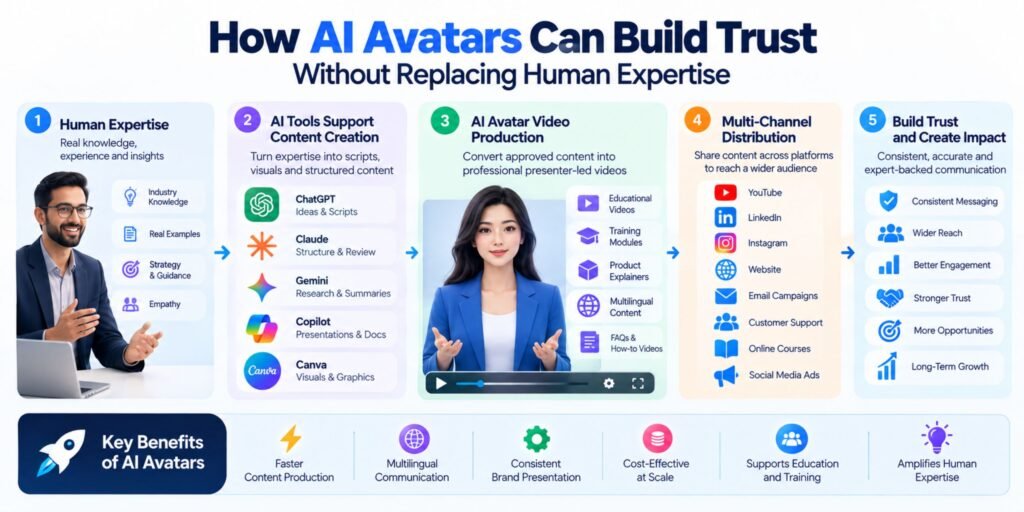
AI tools such as ChatGPT, Claude, Gemini, Microsoft Copilot, Canva, and AI avatar platforms can support this process, but human expertise should remain at the center.
What Are AI Avatars?
An AI avatar is a digitally generated or AI-powered presenter that can communicate information through video or other digital experiences.
Depending on the technology, an AI avatar may be able to:
- Speak from a written script
- Present educational content
- Explain products or services
- Deliver training material
- Create marketing videos
- Support multilingual communication
- Produce personalized video content
- Repurpose existing content into video
For marketers, this creates a new way to scale video production.
Instead of requiring a presenter, camera setup, location, editing, and repeated recording for every variation, some content can be produced through an AI-assisted workflow.
However, production efficiency and audience trust are two different things.
Why Human Expertise Still Matters
Imagine watching two videos.
The first uses a perfectly generated AI avatar but contains generic information, exaggerated claims, and no evidence.
The second uses an AI avatar to present information created and reviewed by an experienced marketing professional, with examples, data, clear explanations, and transparent messaging.
The second approach is more likely to communicate expertise because the value comes from the information and experience behind the presentation—not simply from the appearance of the presenter.
Human experts provide:
- Industry knowledge
- Experience
- Context
- Strategic judgment
- Original insights
- Real-world examples
- Accountability
- Empathy
AI avatars can help communicate these things, but they do not create them automatically.
AI Avatars Should Be the Delivery Layer
A useful way to think about AI avatars is:
Human Expertise → AI-Assisted Content → AI Avatar → Audience
The expert remains responsible for the knowledge.
AI tools help transform that knowledge into content.
The avatar becomes the delivery mechanism.
This is a healthier model than:
AI Avatar → Generic AI Content → Audience
The second model can easily result in repetitive, low-value content.
How AI Avatars Can Actually Build Trust
AI avatars can contribute to trust when they are used strategically.
1. Consistent Communication
Businesses often struggle to maintain consistency across their content.
Different presenters may explain the same product differently. Marketing teams may use different terminology across campaigns. Training materials may become outdated.
AI avatars can help businesses maintain a consistent presentation style.
For example, a company could create a series of educational videos where the same avatar explains:
- Product features
- Frequently asked questions
- Training concepts
- Setup instructions
- Industry terminology
The important factor is that the underlying information remains accurate and useful.
Consistency supports recognition, but consistency alone does not equal credibility.
2. Faster Educational Content
AI avatars can make educational content easier to produce.
A training organization can convert a structured lesson into a presenter-led video rather than recording every lesson manually.
For example:
Course Topic
↓
Expert Creates Lesson
↓
ChatGPT Helps Structure Script
↓
Human Expert Reviews Content
↓
AI Avatar Presents Script
↓
Video Published
This can help instructors spend more time developing the actual curriculum while reducing repetitive production work.
For an organization such as IILD, this type of workflow can complement existing digital marketing training by making educational concepts easier to deliver across different content formats.
3. Multilingual Communication
Language can be a barrier to digital communication.
AI-powered video workflows can help businesses adapt educational and marketing content for different languages.
For example, a company could create versions of the same educational video for different audiences.
But translation should still be reviewed for:
- Meaning
- Cultural context
- Industry terminology
- Tone
- Accuracy
AI can accelerate localization, but human review remains important when the content has commercial, technical, or educational consequences.
4. More Frequent Expert-Led Content
One of the biggest challenges for experts is time.
A digital marketing consultant may have valuable knowledge but may not have time to record videos every day.
An AI avatar can help turn existing expertise into additional content formats.
For example:
Expert Webinar
↓
Transcript
↓
ChatGPT → Key Topics
↓
Claude → Content Structure
↓
AI Avatar → Short Educational Videos
↓
Social Media / YouTube / Website
The expert does not need to personally record every piece of derivative content.
This allows one piece of expertise to become multiple educational assets.
5. Personalized Communication
AI avatars can also support personalized video experiences.
For example, businesses could potentially create different versions of a message based on:
- Audience segment
- Industry
- Product interest
- Customer stage
- Geographic market
- Training level
A beginner could receive a basic explanation, while an experienced professional could receive a more technical version.
The AI avatar delivers the customized presentation, while the marketing strategy determines what information each audience should receive.
6. Better Product Demonstrations
Product demonstrations can become repetitive when a company has many products or features.
AI avatars can help explain:
- Product features
- How-to instructions
- Frequently asked questions
- Product comparisons
- Setup processes
- Basic troubleshooting
For technical companies, the expert’s knowledge can be converted into structured scripts and then delivered through AI-assisted video production.
The critical requirement is technical accuracy.
A visually convincing AI presenter explaining incorrect product information can damage trust rather than build it.
AI Tools That Can Support an AI Avatar Workflow
AI avatars are only one component of a larger content system.
Different AI tools can support different stages.
ChatGPT
ChatGPT can help marketers:
- Develop video scripts
- Generate content ideas
- Create hooks
- Simplify complex explanations
- Repurpose long-form content
- Create FAQs
- Adapt scripts for different audiences
The expert should review the final script before publication.
Claude
Claude can help with:
- Long-form script development
- Content restructuring
- Detailed explanations
- Content review
- Training documentation
It can be useful when an expert has a large amount of source material that needs to be transformed into structured educational content.
Gemini
Gemini can support:
- Content ideation
- Research assistance
- Summarization
- Productivity workflows
- Google-oriented content tasks
It can become part of a broader content production workflow.
Microsoft Copilot
Copilot can assist with:
- Presentations
- Documents
- Content summaries
- Marketing reports
- Productivity tasks
This can help marketing teams convert internal knowledge into presentation-ready material.
Canva
Canva can support the visual side of AI-powered video marketing, including:
- Thumbnails
- Presentation graphics
- Social media creatives
- Supporting visual assets
- Branded content
The avatar may be the presenter, but the surrounding visual design still influences how professional and understandable the content feels.
A Practical AI Avatar Content Workflow
A useful workflow for businesses could look like this:
Step 1: Start With Human Expertise
Identify the actual knowledge you want to communicate.
This could come from:
- An expert interview
- Training material
- A webinar
- A product document
- A case study
- A customer FAQ
Step 2: Research and Structure
Use tools such as Perplexity, ChatGPT, Claude, or Gemini to help organize the material.
Step 3: Create the Script
Use AI to create a structured script.
Include:
- Introduction
- Problem
- Explanation
- Example
- Key takeaway
- Call-to-action
Step 4: Human Review
The subject-matter expert should verify:
- Facts
- Claims
- Examples
- Terminology
- Brand messaging
Step 5: Generate the AI Avatar Video
Convert the approved script into an avatar-led video using an appropriate AI video/avatar platform.
Step 6: Add Supporting Visuals
Use graphics, screenshots, charts, animations, or demonstrations where they improve understanding.
Step 7: Publish and Measure
Track:
- Views
- Watch time
- Engagement
- Click-through rate
- Leads
- Conversions
The content should be evaluated based on actual audience response, not simply how realistic the avatar looks.
AI Avatar vs Human Presenter
AI avatars and human presenters each have different strengths.
| Area | AI Avatar | Human Presenter |
| Production speed | High | Lower |
| Repetitive videos | Efficient | Time-consuming |
| Personal connection | Limited | Stronger potential |
| Real experience | Cannot originate it | Can demonstrate it |
| Consistency | High | Varies |
| Spontaneous interaction | Limited | Strong |
| Emotional nuance | Variable | Stronger potential |
| Scalability | High | Limited by time |
| Expertise | Depends on source content | Comes from human knowledge |
This isn’t necessarily an either/or decision.
A business can use both.
Where AI Avatars Should Not Replace Humans
There are situations where human interaction remains particularly valuable.
Expert Consultation
Customers often need personalized advice and context.
Complex Strategy
Strategic decisions require understanding business circumstances rather than simply presenting predefined information.
Sensitive Communication
Some conversations require empathy, nuance, and human accountability.
High-Stakes Decisions
Technical, financial, legal, medical, or other high-consequence information should receive appropriate expert review rather than relying solely on AI-generated content.
Community Building
Audiences often connect with people because of their personality, experience, and authentic perspective.
An AI avatar can support communication, but it doesn’t automatically create that relationship.
Transparency Is Part of Trust
One of the most important considerations when using AI avatars is transparency.
If an audience believes they are watching a real person when they are actually watching an AI-generated presenter, the perceived authenticity can change when they discover the difference.
Businesses should consider clearly communicating when content uses AI-generated presenters, particularly where that distinction could reasonably affect audience understanding or trust.
Transparency can be as simple as:
“This video uses an AI-generated presenter based on expert-reviewed content.”
The exact disclosure should match the context and applicable requirements.
Don’t Confuse Realism With Trust
Modern AI avatars can look increasingly realistic.
But realism is not the same as credibility.
A realistic avatar delivering poor information is still poor communication.
Trust is built through:
Accuracy + Expertise + Transparency + Consistency + Usefulness
not simply:
Realistic Avatar + Good Animation
This distinction is particularly important for businesses using AI video as part of their digital marketing strategy.
AI Avatars and Content Marketing
AI avatars can become part of a broader content repurposing strategy.
One expert article could become:
Blog Article
↓
YouTube Video
↓
AI Avatar Explainer
↓
Short Reel
↓
LinkedIn Post
↓
Email Newsletter
↓
FAQ
AI tools such as ChatGPT, Claude, and Gemini can help with repurposing, while automation tools such as n8n and Make can connect different parts of the workflow.
This allows marketing teams to extract more value from existing expertise.
How AI Avatars Can Support Digital Marketing Training
AI avatars have an especially interesting application in education and professional training.
A course instructor can create a lesson once and then adapt it into:
- Short videos
- Topic explainers
- Revision videos
- FAQs
- Course introductions
- Practical demonstrations
- Social media educational content
For digital marketing training, an AI avatar could explain concepts such as:
- SEO
- Google Ads
- Meta Ads
- GA4
- Google Tag Manager
- Conversion tracking
- AI-powered marketing
- Marketing automation
But the curriculum, examples, exercises, and strategic guidance should continue to come from qualified trainers and real-world marketing experience.
How IILD Can Use AI Avatars as a Training and Marketing Tool
For a marketing training organization like IILD, AI avatars can complement—not replace—the trainer-led learning experience.
For example, the workflow could be:
IILD Trainer Expertise
↓
Course Material
↓
ChatGPT / Claude / Gemini
↓
Script Development
↓
Expert Review
↓
AI Avatar Video
↓
Website / YouTube / Social Media
This could help create supporting educational content around IILD’s areas of training, including:
- AI-powered performance marketing
- SEO
- Google Ads
- Meta Ads
- Digital analytics
- Marketing automation
- AI tools
The trainer remains the source of expertise, while AI improves content production and distribution.
The Future: Human Expertise + AI Scale
The most useful question isn’t:
“Will AI avatars replace human experts?”
A better question is:
“How can human experts use AI avatars to communicate their knowledge more efficiently?”
That shift changes the entire conversation.
An expert can focus on:
- Research
- Strategy
- Teaching
- Experience
- Original insights
- Decision-making
AI can assist with:
- Content production
- Script formatting
- Repurposing
- Translation
- Video production
- Distribution
- Automation
This creates a hybrid model where technology increases the reach of human expertise.
Conclusion
AI avatars can make digital content faster, more scalable, and easier to produce. They can support marketing campaigns, educational videos, product explanations, multilingual content, and content repurposing.
But AI avatars should not be mistaken for expertise.
The strongest model is:
Human Expertise → AI Tools → AI Avatar → Useful Content → Audience Trust
Tools such as ChatGPT, Claude, Gemini, Microsoft Copilot, Canva, n8n, Make, and AI Agents can help marketers build this workflow more efficiently.
The avatar should handle the presentation.
The human should provide the knowledge, judgment, experience, and accountability. That is how businesses can use AI avatars to scale communication without scaling away the human expertise that makes the communication valuable.