
Introduction
For years, performance marketing was largely associated with two platforms: Google Ads and Meta Ads.
Marketers would launch campaigns, select audiences, manage budgets, monitor CPC, CPA and ROAS, and optimize campaigns based on conversion data.
That approach still matters—but it is no longer enough.
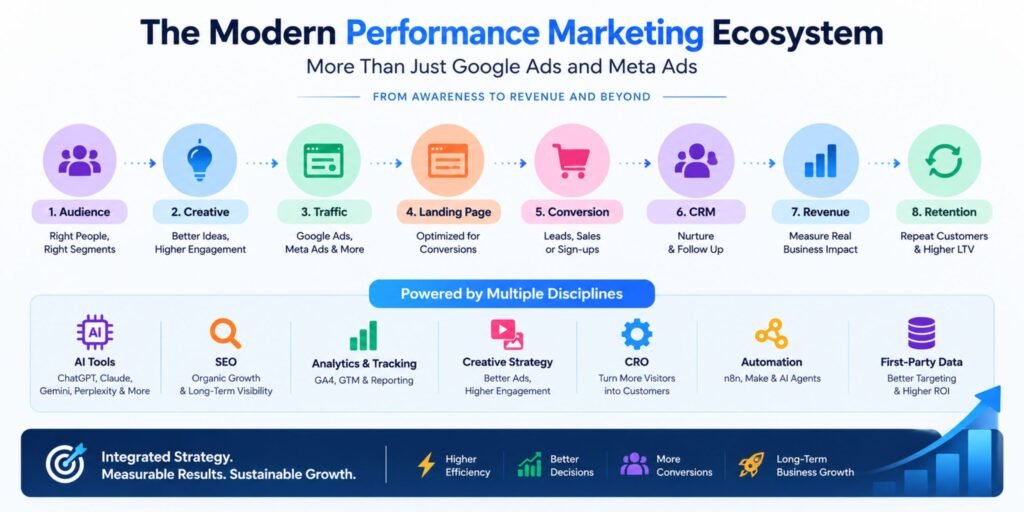
In 2026, performance marketing has become a much broader discipline involving AI, SEO, analytics, conversion rate optimization, creative strategy, automation, customer journeys, attribution, and first-party data.
Google Ads and Meta Ads remain important acquisition channels, but they are only parts of the larger performance marketing system.
A campaign can have excellent targeting and still fail because the landing page is weak. An ad can generate thousands of clicks but produce poor-quality leads. A business can have strong ROAS while losing money because customer lifetime value is ignored.
Modern performance marketers therefore need to think beyond individual advertising platforms.
What Is Performance Marketing?
Performance marketing is a data-driven approach where marketing activities are measured against specific business outcomes.
Depending on the business, those outcomes might include:
- Leads
- Sales
- App installs
- Registrations
- Bookings
- Qualified opportunities
- Revenue
- Customer acquisition
The important distinction is that performance marketing focuses on measurable results, not simply visibility.
A modern performance marketing framework looks more like:
Audience → Creative → Traffic → Landing Page → Conversion → CRM → Revenue → Retention
Google Ads and Meta Ads may generate the traffic, but the entire journey determines whether that traffic becomes profitable business.
Why Google Ads and Meta Ads Are Not Enough
The biggest mistake is treating the advertising platform as the entire marketing strategy.
Suppose a Meta Ads campaign generates leads at a low cost.
That sounds positive.
But what if most of those leads are unqualified?
Or suppose Google Ads generates conversions at an attractive CPA.
What if the landing page is converting only 2% of qualified visitors?
The platform may not be the actual problem.
Performance depends on several interconnected components:
- Audience
- Offer
- Creative
- Ad copy
- Landing page
- Tracking
- Conversion process
- Lead quality
- Sales follow-up
- Customer lifetime value
This is why performance marketing in 2026 requires a systems-level approach.
1. AI Is Becoming Part of the Performance Marketing Workflow
Artificial intelligence is one of the biggest changes in modern performance marketing.
AI can help marketers with:
- Campaign research
- Audience analysis
- Ad copy
- Creative ideation
- SEO research
- Landing page messaging
- Data analysis
- Reporting
- Automation
- Lead qualification
Tools such as ChatGPT, Claude, Gemini, Perplexity, Microsoft Copilot, n8n, Make, and AI Agents can support different parts of the marketing workflow.
For example:
Perplexity → Market research
↓
ChatGPT → Campaign concepts
↓
Claude → Strategy and messaging analysis
↓
Gemini → Google-oriented workflows
↓
GA4 → Performance measurement
↓
n8n / Make → Automation
AI doesn’t eliminate the need for marketers.
It changes what marketers spend their time doing.
2. Creative Strategy Matters More Than Ever
Performance marketing isn’t only about targeting.
Creative is often one of the most important variables in paid advertising performance.
Marketers need to continuously test:
- Hooks
- Headlines
- Visuals
- Videos
- Offers
- CTAs
- Messaging angles
- Formats
- Audience-specific communication
AI tools can accelerate this process.
For example, ChatGPT can generate multiple messaging angles, while Canva can help turn concepts into different creative formats.
A marketer can then test those variations through Meta Ads or other advertising platforms and use actual performance data to determine which concepts deserve further investment.
The process becomes:
AI-assisted ideation → Creative production → A/B testing → Data analysis → Iteration
That is very different from creating one advertisement and leaving it unchanged for months.
3. SEO Is Part of Performance Marketing
SEO is sometimes treated as a completely separate discipline from performance marketing.
That distinction is becoming less useful.
Organic search can reduce dependence on paid acquisition and generate high-intent traffic over time.
Modern SEO strategies can include:
- Keyword research
- Search intent
- Technical SEO
- Content optimization
- Internal linking
- Conversion-focused content
- Google Search Console
- AI-assisted research
- GEO
- AEO
AI tools such as ChatGPT, Claude, Gemini, and Perplexity can accelerate research and content workflows.
But AI-generated content alone isn’t an SEO strategy.
Marketers still need to understand:
Search intent + content quality + technical SEO + authority + user experience + conversion
4. Analytics Is the Foundation of Performance Marketing
You cannot optimize what you cannot measure.
This makes GA4, Google Tag Manager, conversion tracking, and reporting critical parts of modern performance marketing.
A marketer should be able to answer:
- Where did the user come from?
- Which campaign generated the conversion?
- What did the user do before converting?
- Which landing page performed best?
- Where did users drop off?
- Which channel generated qualified leads?
- What was the actual acquisition cost?
GA4 can help analyze user behavior, while Google Tag Manager can help implement and manage tracking.
Tools such as Looker Studio can then turn marketing data into dashboards that make performance easier to monitor.
AI can support this process by summarizing reports and identifying areas that deserve investigation.
5. Conversion Rate Optimization Is a Performance Skill
Driving more traffic isn’t always the answer.
Sometimes the better solution is converting more of the traffic you already have.
This is where Conversion Rate Optimization (CRO) becomes important.
Consider a landing page receiving:
10,000 visitors → 200 leads
If optimization increases the conversion rate from 2% to 3%, the same traffic produces:
10,000 visitors → 300 leads
No additional advertising traffic was required.
CRO involves testing elements such as:
- Headlines
- Forms
- CTAs
- Page layout
- Social proof
- Offers
- Trust signals
- Page speed
- Mobile experience
AI tools such as ChatGPT and Claude can help generate hypotheses and alternative messaging, but actual performance should be determined through testing.
6. Marketing Automation Is Becoming Essential
Imagine receiving 100 leads from a campaign.
Someone needs to:
- Capture the leads
- Add them to the CRM
- Notify sales
- Send follow-up communication
- Categorize leads
- Track status
- Generate reports
Doing all of this manually doesn’t scale efficiently.
This is where marketing automation becomes valuable.
Platforms such as n8n and Make can connect lead forms, CRM systems, spreadsheets, email platforms, analytics tools, and AI models.
A simple workflow could be:
Meta Lead
↓
n8n / Make
↓
CRM
↓
AI Lead Classification
↓
Sales Notification
↓
Automated Follow-Up
This turns performance marketing into an operational system rather than just an advertising activity.
7. AI Agents Can Take Automation Further
Traditional automation generally follows predefined rules.
AI Agents can potentially handle more complex, multi-step workflows where decisions are required at different stages.
For example, an AI-powered marketing workflow could:
- Receive campaign data.
- Identify unusual performance changes.
- Summarize the issue.
- Compare current results with historical performance.
- Prepare an optimization recommendation.
- Send the report to the marketing team.
The human marketer remains responsible for important strategic decisions and approvals.
The role of AI is to reduce repetitive analysis and operational work.
This is why AI Agents and AI workflows are becoming relevant skills for future performance marketers.
8. First-Party Data Matters
Performance marketing increasingly depends on the quality of the data businesses own and can responsibly use.
First-party data can include:
- Customer information
- CRM records
- Purchase history
- Website interactions
- Lead quality
- Customer lifecycle information
This data can help marketers understand not just which campaign generated a lead, but whether that lead eventually became a customer.
That distinction matters.
A campaign generating inexpensive leads isn’t necessarily successful if those leads rarely convert into paying customers.
9. ROAS Is Not the Only Metric That Matters
ROAS is useful, but relying on it alone can create misleading conclusions.
Modern performance marketers should also consider:
CPA
How much does it cost to acquire a conversion?
CAC
How much does it cost to acquire a customer?
LTV
How much revenue or value does a customer generate over their relationship with the business?
Conversion Rate
What percentage of users complete the desired action?
Lead Quality
How many generated leads are actually valuable to the business?
Revenue
How much actual business revenue is generated?
A campaign shouldn’t be scaled simply because one metric looks good.
Performance should be evaluated against the business objective.
10. Full-Funnel Thinking Is Critical
A modern performance marketing strategy should consider the entire customer journey.
Top of Funnel
Focus:
- Awareness
- Reach
- Discovery
- New audiences
Middle of Funnel
Focus:
- Engagement
- Consideration
- Retargeting
- Education
Bottom of Funnel
Focus:
- Leads
- Purchases
- Bookings
- Conversions
Post-Conversion
Focus:
- Retention
- Upselling
- Cross-selling
- Customer lifetime value
Google Ads and Meta Ads can operate across different funnel stages, but marketers need to understand what each campaign is trying to accomplish.
11. Performance Marketing Requires Experimentation
Successful performance marketing isn’t about finding one perfect campaign.
It’s about continuously learning.
Marketers should test:
- Audiences
- Creatives
- Offers
- Landing pages
- Ad copy
- CTAs
- Campaign structures
- Budget allocation
AI tools can accelerate hypothesis generation, but experimentation still requires proper measurement.
A useful cycle is:
Hypothesis → Test → Measure → Learn → Optimize → Test Again
This creates a continuous improvement loop.
12. The Modern Performance Marketing Stack
A performance marketer in 2026 may work with a much broader technology stack than just Google Ads and Meta Ads.
Advertising
- Google Ads
- Meta Ads
- LinkedIn Ads
Analytics
- GA4
- Google Tag Manager
- Looker Studio
AI
- ChatGPT
- Claude
- Gemini
- Perplexity
- Microsoft Copilot
SEO
- Google Search Console
- Semrush
- AI-assisted SEO workflows
Automation
- n8n
- Make
- AI Agents
CRM
- Lead management
- Customer lifecycle tracking
- Automated follow-up
The important skill isn’t memorizing every platform.
It’s understanding how the platforms work together.
What Skills Should a Performance Marketer Learn in 2026?
If you’re building a career in performance marketing, focus on a combination of technical, analytical, creative, and strategic skills.
Core Marketing
- Marketing fundamentals
- Customer journey
- Funnel strategy
- Offer positioning
Paid Media
- Google Ads
- Meta Ads
- Campaign structure
- Audience targeting
- Creative testing
- Budget management
Analytics
- GA4
- Google Tag Manager
- Conversion tracking
- Attribution
- Reporting
SEO
- Keyword research
- Search intent
- On-page SEO
- Technical SEO
- GEO
- AEO
AI
- ChatGPT
- Claude
- Gemini
- Perplexity
- Copilot
- AI Agents
Automation
- n8n
- Make
- CRM workflows
- Automated reporting
Optimization
- CRO
- A/B testing
- Landing page optimization
- Creative testing
This combination is much more valuable than knowing how to operate one advertising platform in isolation.
How IILD’s Training Approach Fits the New Performance Marketing Landscape
Modern performance marketing training needs to reflect how marketing teams actually work.
Learning Google Ads and Meta Ads is important, but learners also need to understand what happens before and after the click.
IILD’s approach can connect performance marketing with:
- AI-powered marketing
- SEO
- Google Ads
- Meta Ads
- GA4
- Google Tag Manager
- Conversion tracking
- Analytics
- Marketing automation
- AI workflows
- Reporting
- CRO
AI tools such as ChatGPT, Claude, Gemini, Perplexity, Microsoft Copilot, n8n, Make, and AI Agents can be integrated into practical marketing workflows rather than taught as isolated software tools.
For someone learning performance marketing, the goal should be to understand the complete system:
Plan → Create → Launch → Track → Analyze → Optimize → Automate → Scale
What Will Separate Good Performance Marketers from Average Ones?
The difference won’t simply be who knows how to create a Google Ads campaign.
It will be who can answer:
Why did performance change?
Which data should we trust?
Is the problem the audience, creative, offer, landing page, or sales process?
Can we automate the repetitive work?
Are we optimizing for leads or actual revenue?
What should we test next?
AI can help marketers answer some of these questions faster, but strong marketing judgment remains essential.
Conclusion
Performance marketing in 2026 is much bigger than Google Ads and Meta Ads.
Paid advertising remains a critical part of the ecosystem, but sustainable growth requires much more: AI, SEO, analytics, conversion tracking, CRO, creative testing, automation, CRM, first-party data, and full-funnel strategy.
Tools such as ChatGPT, Claude, Gemini, Perplexity, Copilot, n8n, Make, and AI Agents can help marketers execute these activities faster and build more connected workflows.
But tools alone don’t create performance.
The real advantage comes from combining:
Marketing Strategy + AI + Paid Media + SEO + Analytics + Automation + Optimization
That is the skill set modern performance marketers need to build campaigns that don’t just generate clicks—but generate measurable business growth.