
Introduction
Performance marketing is no longer just about launching Google Ads or Meta Ads and watching the numbers move. Modern marketers are expected to research faster, create more variations, analyze campaign data, optimize landing pages, automate repetitive tasks, and make decisions based on measurable business outcomes.
Artificial intelligence is changing how these tasks are performed. Tools such as ChatGPT, Claude, Gemini, Perplexity, Microsoft Copilot, n8n, and Make can help marketers reduce repetitive work and build more efficient marketing workflows.
However, simply knowing how to open an AI tool isn’t a performance marketing skill. The real advantage comes from knowing which tool to use, what task to give it, how to validate its output, and how to connect it with the rest of your marketing workflow.
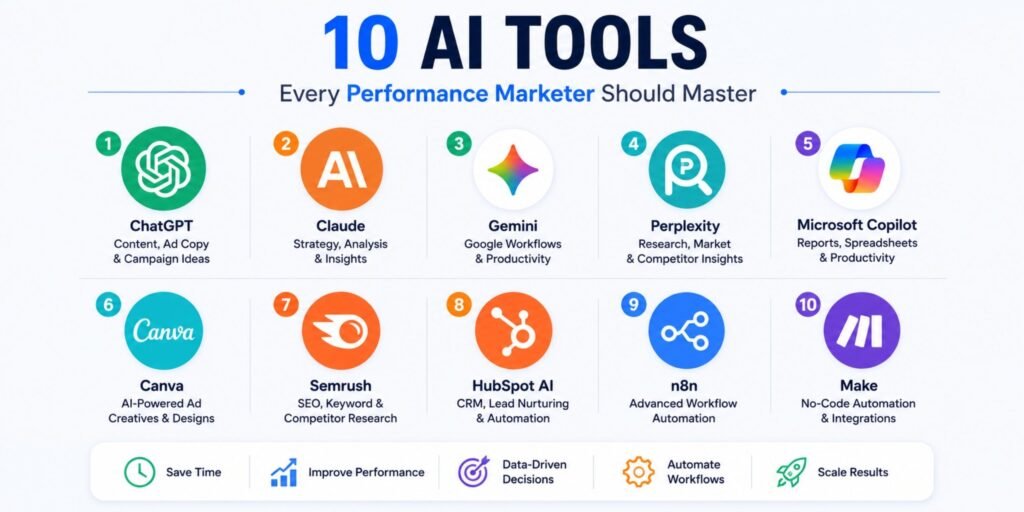
Here are 10 AI tools and AI-powered platforms that performance marketers should understand in 2026.
1. ChatGPT – For Marketing Content and Campaign Execution
ChatGPT is one of the most versatile AI tools for performance marketers. It can assist with content creation, campaign planning, ad copy, audience research, SEO workflows, reporting, and marketing strategy.
A performance marketer can use ChatGPT to create multiple variations of:
- Google Ads headlines
- Meta Ads primary text
- Social media captions
- Landing page headlines
- Email campaigns
- Blog outlines
- Calls-to-action
- A/B testing ideas
For example, instead of creating one advertisement manually, a marketer can use ChatGPT to develop several messaging angles for different audience segments and then test the strongest variations through the advertising platform.
Best for: Content creation, ad copy, campaign ideas, SEO, strategy, and productivity.
Performance marketing use case:
Audience insight → ChatGPT → Multiple ad concepts → A/B testing → Performance analysis
2. Claude – For Strategy and Deep Marketing Analysis
Claude can be particularly useful when marketers need to work with lengthy documents, reports, campaign information, or strategic material.
Performance marketers can use Claude to help analyze:
- Campaign reports
- Customer research
- Competitor information
- Content strategies
- Marketing plans
- Landing page messaging
- Performance summaries
For example, a marketer could provide structured campaign data and ask Claude to identify potential patterns, questions worth investigating, and areas that deserve further analysis.
The important distinction is that AI should help identify opportunities—not make unsupported conclusions from incomplete data.
Best for: Strategy, long-form analysis, campaign reviews, and marketing documentation.
Performance marketing use case:
Campaign data → Claude → Identify patterns → Marketing hypotheses → Human validation
3. Gemini – For Google-Centric Marketing Workflows
Google Gemini is particularly relevant for marketers who work extensively within Google’s ecosystem and productivity tools.
It can assist with:
- Content ideation
- Research
- Spreadsheet analysis
- Marketing documentation
- Data interpretation
- Campaign planning
- Productivity tasks
For marketers working with Google Ads, GA4, Google Sheets, Google Docs, and other Google-oriented workflows, Gemini can become part of their broader marketing productivity stack.
For example, a marketer can use AI assistance to interpret a campaign spreadsheet, identify areas requiring attention, and prepare a structured performance summary.
Best for: Google-oriented workflows, productivity, research, and data-related marketing tasks.
Performance marketing use case:
Marketing data → Gemini → Analysis support → Report preparation → Optimization decisions
4. Perplexity – For Marketing Research
Performance marketing decisions depend heavily on research.
Before creating a campaign, marketers need to understand:
- Customer problems
- Competitor positioning
- Industry trends
- Search behavior
- Product comparisons
- Market questions
- Content opportunities
Perplexity can help marketers conduct research and quickly explore information across multiple sources.
It can be useful during the research stage of:
- SEO campaigns
- Content marketing
- Competitor analysis
- Audience research
- Market research
- Campaign planning
However, marketers should still verify important claims against reliable primary sources before using them in advertising or published content.
Best for: Research, market exploration, competitor research, and topic discovery.
Performance marketing use case:
Research question → Perplexity → Source discovery → Validate information → Campaign strategy
5. Microsoft Copilot – For Reports, Spreadsheets and Productivity
Performance marketers spend a surprising amount of time working with spreadsheets, presentations, documents, and reports.
Microsoft Copilot can help streamline these tasks within Microsoft’s productivity environment.
Potential marketing applications include:
- Spreadsheet analysis
- Report summaries
- Presentation preparation
- Marketing documentation
- Data organization
- Meeting summaries
- Content drafting
For example, instead of manually turning campaign numbers into a presentation, marketers can use AI assistance to organize the information and create a first draft of the reporting narrative.
The marketer still needs to verify the numbers and conclusions before sending the report to a client or management team.
Best for: Reporting, spreadsheets, presentations, and productivity.
Performance marketing use case:
Campaign data → Copilot → Report structure → Presentation → Human review
6. Canva – For AI-Assisted Ad Creatives
Performance marketing isn’t only about numbers. Creative quality can directly affect engagement and conversion performance.
Canva’s AI-powered features can assist marketers with creating and adapting visual assets for different advertising formats.
Marketers can use it for:
- Social media creatives
- Ad banners
- Presentation graphics
- Campaign variations
- Visual content
- Resizing designs
- Creative concepts
For a Meta Ads campaign, for example, a marketer can develop several visual directions and adapt them to different placements and dimensions.
AI can accelerate creative production, but marketers still need to evaluate whether the creative communicates the offer clearly and matches the target audience.
Best for: Ad creatives, social media graphics, campaign visuals, and design productivity.
Performance marketing use case:
Campaign concept → AI-assisted design → Creative variations → Ad testing → Performance analysis
7. Semrush – For AI-Assisted SEO and Competitive Research
Performance marketing often includes both paid and organic acquisition.
Semrush provides tools for SEO, keyword research, competitive analysis, content, and advertising research, with AI-assisted capabilities available across parts of its platform.
Marketers can use it to investigate:
- Keyword opportunities
- Competitor visibility
- Search trends
- Content gaps
- Paid search information
- SEO performance
Combining Semrush with generative AI can create a more efficient research workflow.
For example:
Semrush → Keyword and competitor data
↓
ChatGPT → Content strategy
↓
Claude → Content analysis
↓
GA4/Search Console → Performance measurement
Best for: SEO, competitive research, keyword analysis, and search marketing.
8. HubSpot AI – For Marketing and Lead Management
Performance marketing does not end when someone submits a lead form.
The real question is:
What happens to the lead afterward?
AI-powered CRM and marketing platforms such as HubSpot can help marketers connect lead generation with CRM, content, email, and customer journeys.
Potential applications include:
- Lead management
- Email content
- CRM workflows
- Customer segmentation
- Lead nurturing
- Marketing reporting
- Campaign organization
For example, a paid campaign can generate leads that enter a CRM workflow, where subsequent communication and qualification processes are automated according to predefined rules.
Best for: CRM, lead nurturing, inbound marketing, and customer lifecycle workflows.
9. n8n – For AI Marketing Automation
Creating content or analyzing data with AI is useful.
Automating the entire workflow is even more powerful.
n8n allows marketers to build visual workflows connecting different applications, APIs, databases, and AI models.
A performance marketing workflow could look like:
Lead Form
↓
n8n
↓
CRM
↓
AI Lead Summary
↓
Sales Notification
↓
Follow-Up Workflow
Another example could automate reporting:
Marketing Data → n8n → AI Analysis → Report → Email
This reduces repetitive manual work and allows marketers to spend more time on strategy and optimization.
Best for: Workflow automation, AI integrations, lead management, and reporting automation.
10. Make – For No-Code Marketing Automation
Make is another powerful automation platform that can connect marketing applications and automate repetitive workflows.
Performance marketers can use automation to connect:
- Lead forms
- CRM systems
- Google Sheets
- Email platforms
- Marketing databases
- AI tools
- Reporting systems
For example:
Meta Lead → Make → Google Sheet → CRM → Email Notification
AI can be added to the workflow to classify, summarize, or enrich information where appropriate.
This makes Make particularly useful for marketers who want automation without building everything from scratch with code.
Best for: No-code automation, lead workflows, reporting, and application integration.
How to Choose the Right AI Tool
One mistake marketers make is trying to use every AI tool for every task.
That’s inefficient.
Instead, build a task-based AI stack.
| Marketing Task | Recommended Tool |
| Content & Ad Copy | ChatGPT |
| Long-form Strategy | Claude |
| Google-oriented Workflows | Gemini |
| Research | Perplexity |
| Reports & Productivity | Microsoft Copilot |
| Ad Creatives | Canva |
| SEO & Competitive Research | Semrush |
| CRM & Lead Nurturing | HubSpot AI |
| Advanced Automation | n8n |
| No-Code Automation | Make |
The best tool depends on the workflow, not the popularity of the tool.
How Performance Marketers Can Combine AI Tools
The biggest opportunity isn’t using one AI tool in isolation.
It is connecting several tools into a structured workflow.
Example 1: AI-Powered Content Workflow
Perplexity
Research the topic and identify useful sources.
↓
ChatGPT
Create the content structure and initial draft.
↓
Claude
Review the structure and improve clarity.
↓
Semrush
Check keyword and competitive opportunities.
↓
Human Review
Validate accuracy, brand voice, and search intent.
Example 2: AI-Powered Lead Generation Workflow
Meta Ads / Google Ads
Generate leads.
↓
n8n / Make
Capture and route the lead.
↓
AI Model
Summarize or classify the lead according to predefined criteria.
↓
CRM
Store lead information.
↓
Sales Team
Follow up with qualified prospects.
This reduces repetitive administrative work while keeping humans involved in important decisions.
AI Tools for Performance Marketing Reporting
Reporting is another area where AI can save marketers significant time.
A typical reporting workflow could combine:
GA4 + Google Ads + Meta Ads
↓
Data Collection
↓
n8n / Make
↓
ChatGPT / Claude / Gemini
↓
Performance Summary
↓
Looker Studio / Spreadsheet / Presentation
Instead of spending hours manually rewriting numbers, marketers can focus on interpreting what the numbers mean.
But AI-generated reports should always be checked against the original data.
What AI Cannot Replace in Performance Marketing
AI tools are powerful, but they don’t eliminate the need for marketing expertise.
A marketer still needs to understand:
- Customer psychology
- Offer positioning
- Funnel strategy
- Campaign objectives
- Budget allocation
- Attribution
- Conversion tracking
- Creative testing
- Landing page optimization
- Business economics
- CPA and ROAS
- Customer lifetime value
For example, ChatGPT can generate 20 ad headlines.
It cannot automatically determine whether the underlying offer is commercially viable.
Similarly, an AI system can summarize campaign data, but the marketer still needs to understand why performance changed and what action should be taken.
The Right Way to Learn AI for Performance Marketing
Don’t try to memorize dozens of AI tools.
Instead, learn AI through actual marketing workflows.
Start with:
Step 1: Learn Marketing Fundamentals
Understand SEO, paid advertising, funnels, conversion rates, CPA, ROAS, and customer journeys.
Step 2: Learn Core AI Tools
Start with:
ChatGPT + Claude + Gemini + Perplexity
Step 3: Learn Analytics
Understand:
GA4 + Google Tag Manager + campaign tracking
Step 4: Learn Automation
Explore:
n8n + Make
Step 5: Build Real Workflows
Combine AI, analytics, advertising, and automation into practical projects.
This approach creates a much stronger skill set than simply collecting AI tool certifications.
How IILD’s AI-Powered Performance Marketing Training Fits In
For beginners and working professionals, the challenge is often not finding AI tools—it is understanding how those tools fit into actual marketing work.
IILD’s AI-powered performance marketing training can connect AI tools with practical areas such as:
- SEO
- Google Ads
- Meta Ads
- Content marketing
- Analytics
- Conversion tracking
- Marketing automation
- Performance reporting
- AI workflows
Learners can explore tools such as ChatGPT, Claude, Gemini, Copilot, Perplexity, n8n, Make, and AI Agents alongside core digital marketing skills.
The objective should be to understand the complete workflow:
Strategy → Execution → Tracking → Analysis → Optimization → Automation
That is where AI becomes useful—not simply as a content generator, but as part of a measurable marketing system.
Final Thoughts
AI is changing performance marketing, but the biggest advantage doesn’t come from knowing the largest number of tools.
It comes from knowing how to apply the right tool to the right marketing problem.
ChatGPT can accelerate content and campaign execution.
Claude can support strategy and analysis.
Gemini can assist with Google-oriented workflows.
Perplexity can accelerate research.
Copilot can improve reporting and productivity.
Canva can speed up creative production.
Semrush can support SEO and competitive research.
HubSpot AI can support CRM and lead nurturing.
n8n and Make can connect these activities into automated workflows.
For performance marketers, the future isn’t AI vs humans.
It’s marketers who know how to use AI vs marketers who don’t. The real competitive advantage comes from combining marketing fundamentals + AI tools + analytics + automation + human judgment to build campaigns that are faster to execute, easier to measure, and more scalable.