
After major shopping events such as Diwali, consumer purchasing behaviour can change. Promotional urgency decreases, discount-driven demand may slow down, and advertisements that performed well during the festive period may no longer generate the same results.
For performance marketers, this creates an important question: How can businesses maintain advertising performance and scale Meta Ads profitably after the festive season?
Increasing the advertising budget is not always the answer. Businesses need to analyse campaign performance, identify profitable products, refresh advertising creatives, improve conversion tracking, and use automation intelligently.
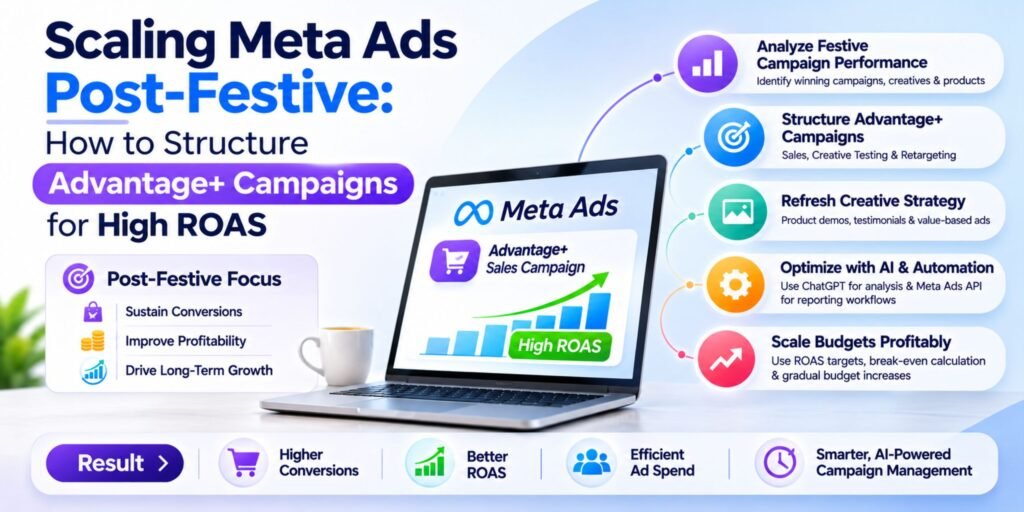
Meta’s Advantage+ campaign capabilities can support this process by using machine learning to optimize advertising delivery. When combined with a structured campaign strategy, ChatGPT, and Meta Marketing API, marketers can build more efficient campaign management and reporting workflows.
In this article, we will explore how to structure Meta Advantage+ campaigns after the festive season, manage advertising budgets, improve creative performance, and use AI-powered workflows to support high-ROAS campaigns.
1. Understanding the Post-Festive Advertising Challenge
During the festive season, customers are often motivated by limited-time discounts, special offers, gifting requirements, and seasonal promotions.
Businesses may experience increased website traffic, higher purchase intent, and stronger conversion volumes during this period.
However, these conditions do not necessarily continue after the festive season.
Several factors can affect Meta Ads performance.
Reduced Purchase Intent
Customers who were actively shopping during the festive season may have already completed their purchases. Others may postpone buying decisions until the next promotional event.
As a result, campaigns that previously generated consistent conversions may experience lower purchase volumes.
Creative Fatigue
Festive advertisements often use similar messages, including:
- Festive Mega Sale
- Diwali Special Offers
- Limited-Time Discounts
- Buy More, Save More
- Special Festive Collections
After repeated exposure, customers may become less responsive to these messages.
Increased Advertising Costs
Advertising costs can fluctuate depending on competition, audience demand, seasonality, and campaign performance. A change in CPM or cost per purchase can affect campaign profitability.
Discount Dependency
If customers purchase primarily because of heavy discounts, the brand may struggle to maintain sales when regular pricing returns.
Inventory and Product Demand Changes
Some products may experience strong seasonal demand but weaker demand afterward. Businesses must identify which products have continued customer interest and sufficient inventory before increasing advertising budgets.
The solution is to shift from festive promotion-based advertising to product-value-driven and conversion-focused marketing.
2. What Are Meta Advantage+ Campaigns?
Meta Advantage+ refers to a collection of advertising automation features that use Meta’s machine learning systems to support campaign delivery and optimization.
Depending on the campaign type and available account settings, these capabilities can help advertisers optimize audience delivery, placements, creative variations, and other campaign elements.
For ecommerce businesses, Advantage+ Sales campaigns are particularly relevant because they are designed to help advertisers generate sales through automated campaign optimization.
Key Benefits of Advantage+ Campaigns
1. Automated audience optimization
Advantage+ audience capabilities can use available audience signals and other information to help Meta identify people who may be more likely to convert.
2. Advantage+ placements
Meta can distribute advertisements across eligible placements, including Facebook, Instagram, and other supported placements, based on campaign delivery opportunities.
3. Campaign delivery optimization
Meta’s machine learning systems use available conversion signals to optimize advertising delivery toward the selected campaign objective.
4. Creative optimization
Available creative enhancements can adapt certain advertising assets for different placements and experiences. Marketers should review these variations to ensure that the product information and brand message remain accurate.
5. Simplified campaign management
Automation can reduce some manual campaign management activities, allowing marketers to focus on creative strategy, performance analysis, and business profitability.
However, Advantage+ does not automatically guarantee higher ROAS. Its performance depends on several factors, including product demand, conversion tracking, creative quality, pricing, website experience, and campaign economics.
3. Analyse Festive Campaign Performance Before Scaling
One of the most common mistakes in post-festive advertising is increasing budgets without understanding why a campaign performed well during the festive season.
A campaign may have generated strong ROAS because of heavy discounts, seasonal demand, or increased purchase intent.
Before scaling, marketers should conduct a detailed campaign audit.
A. Analyse Campaign-Level Performance
Review the following metrics:
| Metric | What it tells you |
| Amount Spent | Total advertising investment |
| Purchases | Number of attributed purchases |
| Purchase Conversion Value | Revenue attributed to advertisements |
| ROAS | Revenue generated per unit of advertising spend |
| Cost per Purchase | Average advertising cost per attributed purchase |
| CPM | Cost per 1,000 impressions |
| CTR | Percentage of impressions resulting in clicks |
| Frequency | Average number of times people see an advertisement |
These metrics help identify whether campaigns are generating meaningful conversions or simply attracting traffic.
B. Analyse Ad-Level Performance
Evaluate individual advertisements to understand which creative concepts are generating purchases.
Identify:
- Advertisements generating consistent conversions.
- Creatives with strong clicks but weak purchases.
- Ads experiencing increasing frequency and declining performance.
- Product demonstrations generating purchase interest.
- Customer testimonials supporting purchase decisions.
Do not select winning advertisements based only on likes, comments, or engagement. For conversion-focused campaigns, purchases and conversion value should remain central to evaluation.
C. Analyse Product-Level Performance
Not every festive bestseller will remain profitable after the season.
Review products based on:
- Purchase volume.
- Contribution margin.
- Customer demand.
- Inventory availability.
- Average order value.
- Repeat purchase potential.
- Return and cancellation rates.
For example, a fashion ecommerce brand may find that its festive collection generated strong sales during Diwali, while everyday clothing continues to attract customers afterward.
The brand should prioritize products with ongoing demand instead of continuing to promote every festive bestseller.
Practical tip: Compare the last 7, 14, and 30 days of campaign performance where sufficient data is available. Consider promotional differences, attribution delays, and changes in demand before drawing conclusions.
4. How to Structure Advantage+ Campaigns After the Festive Season
A complicated campaign structure can make performance analysis difficult. Creating too many campaigns and ad sets with limited budgets may also fragment conversion data.
For many ecommerce businesses, a simplified campaign structure can be a useful starting point.
Campaign 1: Core Advantage+ Sales Campaign
Main conversion campaign
The core Advantage+ Sales campaign should focus on products with proven demand, reliable purchase tracking, and suitable profit margins.
Suggested campaign configuration:
| Setting | Recommended approach |
| Campaign Objective | Sales |
| Conversion Location | Website, where applicable |
| Performance Goal | Maximize conversions or conversion value, depending on the business objective and available options |
| Audience | Advantage+ audience capabilities, with relevant audience guidance |
| Placements | Advantage+ placements, unless there is a clear reason to restrict them |
| Creatives | Multiple distinct creative concepts |
| Primary Measurement | Purchases, purchase value, cost per purchase, and ROAS |
The purpose is to provide Meta’s delivery system with suitable conversion signals while maintaining control over business objectives, creative quality, and measurement.
Campaign 2: Creative Testing Campaign
Creative experimentation
Post-festive advertising requires fresh messaging.
Instead of continuously using festive advertisements, test different creative formats and customer-focused messages.
| Creative format | Example message |
| Product demonstration | See how the product works |
| Customer testimonial | Discover genuine customer experiences |
| Problem-solution video | Show how the product solves a specific problem |
| Product comparison | Explain important product differences |
| UGC-style video | Present an authentic product experience |
| Value-based creative | Highlight quality, convenience, and product benefits |
Test meaningful creative differences rather than making multiple random changes.
For example, compare two opening hooks for the same product demonstration while keeping the offer and landing page consistent.
Evaluate results using purchase performance and business profitability rather than engagement alone.
Campaign 3: Retargeting and Customer Engagement
Supporting conversion campaign
Not every potential customer purchases during their first interaction with an advertisement.
Retargeting helps businesses reconnect with people who have previously interacted with their brand, subject to available audience sizes and privacy requirements.
Potential audience segments include:
- Website visitors.
- Product viewers.
- Add-to-cart users.
- Checkout initiators.
- Facebook and Instagram engagers.
- Existing customers.
The advertising message should reflect the customer’s previous interaction.
For example:
- Product viewers may benefit from product demonstrations.
- Add-to-cart users may need information about delivery, payment, or product features.
- Existing customers may be interested in complementary products or new collections.
However, avoid creating too many small retargeting audiences. If the audience volume is limited, consolidation may be more effective than excessive segmentation.
5. Budget Scaling Strategy: Increase Spending Without Losing Profitability
Increasing advertising budgets is not the same as increasing profitability.
A campaign can generate higher revenue while producing lower margins. Therefore, businesses should understand their break-even ROAS before scaling.
Step 1: Calculate Current ROAS
Return on Ad Spend measures the revenue attributed to advertising relative to advertising expenditure.
\[ ROAS=\frac{\text{Purchase Revenue}}{\text{Advertising Spend}} \]
Example:
| Metric | Value |
| Advertising Spend | ₹20,000 |
| Purchase Revenue | ₹80,000 |
| ROAS | 4.0 |
This means the campaign generated ₹4 in attributed revenue for every ₹1 spent on advertising.
However, ROAS does not account for all business expenses. A campaign with 4.0 ROAS is not automatically profitable.
Step 2: Calculate Break-Even ROAS
A simplified formula is:
\[ \text{Break-even ROAS}=\frac{1}{\text{Contribution Margin}} \]
Suppose the contribution margin before advertising is 40%.
\[ \frac{1}{0.40}=2.5 \]
The business therefore needs approximately 2.5 ROAS to cover the costs included in that contribution-margin calculation.
Additional costs and the desired profit margin must also be considered when establishing the actual target.
Step 3: Scale Budgets Gradually
Once a campaign demonstrates consistent performance, test controlled budget increases.
For example, if a campaign is spending ₹5,000 per day, an advertiser might test ₹5,500 or ₹6,000 instead of immediately doubling the budget.
This is an illustrative testing approach, not a universal Meta recommendation. The appropriate adjustment depends on conversion volume, account performance, business margins, and available demand.
Step 4: Monitor Performance After Scaling
After making budget changes, evaluate:
- Cost per purchase.
- Purchase volume.
- Purchase conversion value.
- ROAS.
- CPM and CTR.
- Frequency.
- Product inventory.
- Contribution margin after advertising.
Allow sufficient time for meaningful performance evaluation. Avoid making repeated changes in response to short-term fluctuations.
Step 5: Scale Creative Production Alongside Budgets
Increasing campaign budgets without refreshing creative assets can lead to creative fatigue.
Prepare new product demonstrations, customer testimonials, comparison videos, and value-based advertisements to maintain creative variety.
The objective is to increase advertising investment only when the business can support additional profitable demand.
6. Creative Strategy: Move Beyond Festive Discounts
During festive campaigns, discounts and urgency can influence purchase decisions.
After the festive season, advertisements should communicate why customers should purchase the product even without a major seasonal offer.
Five Creative Angles to Test
1. Product-benefit advertisements
Explain the practical benefits of the product. Use product demonstrations and clear visuals to communicate its value.
2. Customer testimonial advertisements
Use genuine customer feedback and testimonials with appropriate permission to build trust.
3. Problem-solution advertisements
Start with a specific customer problem and demonstrate how the product addresses it.
4. Comparison-based advertisements
Highlight relevant product features, specifications, and differences to help customers make informed decisions.
5. Value-based advertisements
Focus on quality, convenience, durability, customer support, and other benefits that justify the purchase price.
How AI Tools Can Improve Creative Production
AI-powered tools can help marketing teams generate creative ideas and prepare multiple advertising variations.
- ChatGPT: Generate advertising hooks, headlines, primary text, and creative briefs.
- Claude: Develop detailed creative concepts and organize customer feedback.
- Gemini: Support research and creative planning.
- Canva AI: Assist with visual variations and design adaptations.
- AI video tools: Support storyboarding, editing, subtitles, and video adaptations.
For example, a performance marketer can use ChatGPT to develop five different hooks for a product demonstration video and then test those variations through Meta Ads.
AI-generated product claims, visuals, and promotional details must be checked before publishing.
7. Conversion Tracking: Build a Reliable Foundation for Meta Ads Optimization
Accurate conversion tracking is essential for successful Meta Ads scaling.
If Meta receives incomplete or duplicated conversion events, its reporting may not accurately reflect actual business activity.
Before increasing budgets, review the following tracking components.
Meta Pixel
Meta Pixel is a browser-based tracking tool that helps businesses measure website activity.
Common events include:
- PageView
- ViewContent
- AddToCart
- InitiateCheckout
- Purchase
Conversions API
Meta Conversions API enables businesses to send relevant conversion events from their server or supported integrations to Meta.
When implemented correctly alongside the Pixel, it can improve the availability of conversion signals.
Event Deduplication
If the Pixel and Conversions API send the same purchase event, the implementation should use matching event names and event IDs so Meta can identify duplicate events.
Purchase Value and Currency
Ensure that purchase events contain the correct transaction value and currency. Incorrect purchase values can distort ROAS reporting.
Event Testing
Use Meta Events Manager and available testing tools to verify that events are firing correctly.
8. Using ChatGPT and Meta Ads API for Smarter Campaign Optimization
Post-festive campaign management requires regular reporting, performance analysis, creative planning, and optimization decisions.
ChatGPT and Meta Marketing API can support these activities through AI-assisted reporting workflows.
How ChatGPT Can Help Performance Marketers
ChatGPT can help with:
- Summarizing campaign performance reports.
- Comparing pre-festive and post-festive performance.
- Identifying campaigns with declining ROAS.
- Analysing changes in cost per purchase.
- Organizing creative performance.
- Generating new advertising concepts.
- Preparing campaign review reports.
- Developing optimization hypotheses.
For example, a marketer can export an approved Meta Ads performance report and use the following prompt:
ChatGPT prompt for Meta Ads analysis
“Analyze this Meta Ads performance report. Compare the last 7 days with the previous 7 days. Identify campaigns where ROAS has declined, cost per purchase has increased, or purchase conversion value has changed significantly.
Present the findings in a table. Highlight possible areas for investigation and suggest what should be checked before increasing campaign budgets.
Do not assume causes that the data does not establish. Clearly distinguish observed results from recommendations.”
Copy prompt
AI should support campaign analysis, not replace the marketer’s judgment. Recommendations must be checked against actual campaign data and business conditions.
What Is Meta Marketing API?
The Meta Marketing API provides programmatic access to supported advertising management and reporting functions.
Depending on account permissions, API access, and implementation, developers can use it to:
- Retrieve campaign, ad set, and advertisement information.
- Access advertising performance insights.
- Build automated reporting systems.
- Integrate advertising data with external dashboards.
- Support campaign management workflows.
- Connect advertising information with other business applications.
Example: AI-Assisted Meta Ads Reporting Workflow
Meta Marketing API
Retrieve campaign performance data
Reporting Database or Spreadsheet
Organize spend, purchases, revenue, and ROAS
ChatGPT Analysis
Summarize trends and identify areas for investigation
Performance Dashboard and Human Review
Evaluate results and approve optimization decisions
Automating Meta Ads Reporting with n8n and Make
Platforms such as n8n and Make can connect compatible applications and support automated reporting processes.
A typical workflow could:
- Retrieve campaign insights through an authorized API integration.
- Store performance data in a spreadsheet or database.
- Calculate important campaign metrics.
- Send a structured report to an AI assistant.
- Generate a performance summary.
- Notify the marketing team for review.
This can reduce repetitive reporting work and help marketing teams identify performance changes more consistently.
However, budget modifications and other consequential campaign actions should remain under appropriate human approval unless a properly tested system has explicit authorization and safeguards.
9. Common Mistakes to Avoid When Scaling Post-Festive Meta Ads
Even campaigns with strong festive performance can lose efficiency when advertisers scale without a clear strategy.
| Common mistake | Better approach |
| Increasing budgets immediately after festive sales | Audit performance and profitability first |
| Continuing to use the same festive creatives | Introduce fresh post-festive messaging |
| Creating too many small campaigns | Simplify campaign structure where appropriate |
| Ignoring product margins | Calculate break-even ROAS |
| Retargeting every audience separately | Consolidate audiences when volumes are small |
| Optimizing only for clicks | Evaluate purchases and conversion value |
| Ignoring tracking errors | Verify Pixel and Conversions API events |
| Making frequent campaign edits | Allow sufficient time for evaluation |
| Depending entirely on automation | Combine AI with human judgment |
| Scaling without checking inventory | Align advertising budgets with product availability |
The most important lesson is that advertising decisions should be driven by profitable demand rather than assumptions based on festive campaign performance.
10. Post-Festive Meta Ads Optimization Checklist
Before increasing campaign budgets, use this checklist to evaluate campaign readiness.
- Review festive campaign performance and identify consistent winners.
- Compare recent 7-day, 14-day, and 30-day performance where sufficient data is available.
- Calculate contribution margin and break-even ROAS.
- Check product demand, pricing, and inventory.
- Review Advantage+ Sales campaign settings.
- Prepare fresh product-focused creative variations.
- Evaluate retargeting audiences and customer segments.
- Verify Meta Pixel and Conversions API events.
- Check purchase values, currency, and event deduplication.
- Connect campaign reporting with ChatGPT or an approved analytics workflow.
- Establish budget-testing rules and performance thresholds.
- Review results before approving further budget increases.
Conclusion: Build a Sustainable Post-Festive Meta Ads Growth Strategy
Post-festive Meta Ads scaling is not about spending more money simply because a campaign performed well during the festive season. It is about understanding which products, audiences, creative concepts, and campaigns can continue generating profitable conversions.
Meta Advantage+ can support advertisers through automated campaign delivery, audience optimization, placements, and creative capabilities. However, successful scaling still requires accurate conversion tracking, strong creative strategy, appropriate budget management, and a clear understanding of business profitability.
By combining Meta Ads automation with ChatGPT, Meta Marketing API, GA4, and workflow automation platforms such as n8n and Make, performance marketers can build more efficient reporting and optimization processes.
For digital marketers, the most valuable skill is knowing how to combine automation with practical campaign management, data analysis, and business decision-making.
At IILD Services, practical performance marketing training can help learners understand campaign planning, tracking implementation, advertising performance analysis, AI tools, and marketing automation workflows.
The objective is not just to generate more sales after the festive season. It is to build a measurable and sustainable advertising strategy that supports business growth throughout the year.
Frequently Asked Questions (FAQs)
1. What is the best Meta Ads strategy after the festive season?
Start by auditing festive campaign results, identifying profitable products and creatives, validating conversion tracking, and restructuring campaigns around ongoing customer demand. Use Advantage+ capabilities where they suit the account and business objective.
2. What is a Meta Advantage+ Sales Campaign?
It is a Meta advertising campaign approach that uses automation and machine learning to optimize sales campaign delivery. Depending on available settings, it can use automated audience, placement, budget, and creative capabilities.
3. How should I scale Meta Ads budgets after a festive sale?
Calculate break-even ROAS, assess consistent purchase performance, and test controlled budget increases. Monitor cost per purchase, conversion value, and profitability instead of relying on short-term fluctuations.
4. Should I continue using festive creatives after the sale?
Not necessarily. Replace expired promotional messages with product demonstrations, customer testimonials, problem-solution videos, product benefits, and relevant ongoing offers.
5. How can ChatGPT help with Meta Ads optimization?
ChatGPT can help analyze exported campaign reports, compare performance periods, summarize trends, generate creative ideas, prepare reports, and suggest areas for investigation. Important recommendations should be validated against actual campaign data.
6. What is the role of Meta Ads API in campaign management?
Meta Marketing API allows authorized applications to access advertising data and perform supported campaign management operations. It can support automated reporting, campaign integrations, and performance dashboards.
7. Why is Conversions API important for Meta Ads?
Conversions API enables businesses to send relevant conversion events from their servers or supported integrations to Meta. When used alongside Meta Pixel with appropriate event deduplication, it can support more reliable conversion measurement.
8. What is a good ROAS for post-festive Meta Ads campaigns? There is no universal good ROAS. It depends on product margins, operating costs, average order value, returns, and business objectives. Calculate break-even ROAS before deciding on a target.