
Introduction
Learning AI has never been easier.
You can search YouTube and find thousands of tutorials explaining ChatGPT, Claude, Gemini, Perplexity, AI Agents, n8n, automation, prompt engineering, and AI-powered marketing.
The problem isn’t access to information.
The problem is knowing what to learn, in what order, how to practice it, and whether you’re actually learning the right skills.
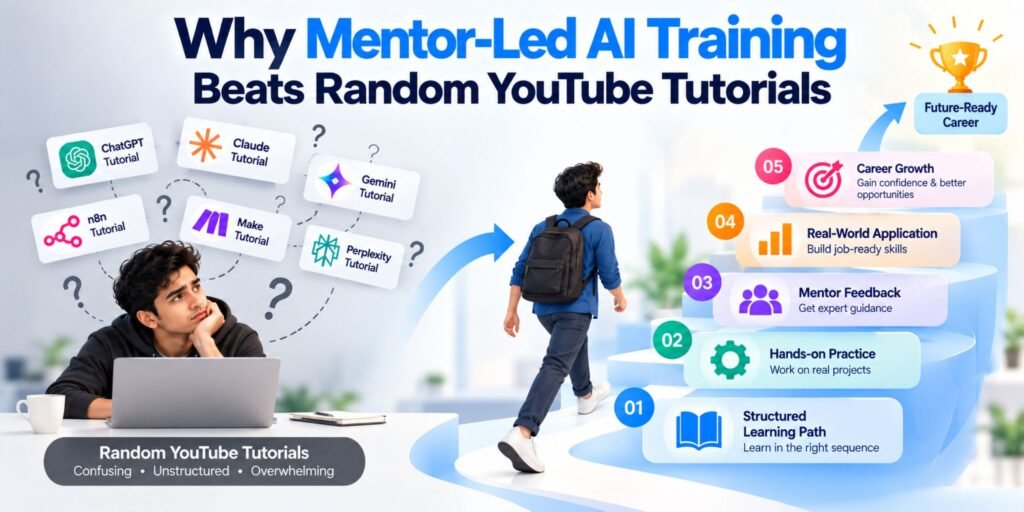
A beginner can watch a tutorial about ChatGPT in the morning, an n8n automation video in the afternoon, and a prompt-engineering video at night. After a few weeks, they may know dozens of AI tools but still struggle to complete a real marketing project.
That’s where mentor-led AI training can provide a different learning model.
Instead of randomly consuming tutorials, learners follow a structured curriculum, work on practical assignments, receive feedback, and have someone experienced available to explain where they are going wrong.
This doesn’t mean YouTube is useless. It is an excellent resource for exploring topics and filling specific knowledge gaps.
The real issue is random learning without a structured path.
What Is Mentor-Led AI Training?
Mentor-led AI training combines structured learning material with guidance from an experienced instructor or mentor.
Instead of simply watching videos, learners typically move through a sequence such as:
Learn → Practice → Get Feedback → Improve → Apply
A mentor can help learners understand:
- Which concepts to learn first
- Which tools are relevant
- How different tools fit together
- How to approach practical problems
- Why an AI-generated result may be incorrect
- How to improve a workflow
- How to apply AI to a specific profession
For an AI-powered digital marketing course, this could mean learning AI alongside:
- SEO
- Google Ads
- Meta Ads
- GA4
- Google Tag Manager
- Conversion tracking
- Content marketing
- Marketing automation
- AI workflows
The focus shifts from learning tools individually to building practical capabilities.
The Problem With Random YouTube Learning
YouTube provides an enormous amount of educational content, but that abundance can become a problem.
Search for:
“Best AI tools for marketers”
You may find videos covering dozens of tools.
Search again tomorrow, and the recommendations may be completely different.
A beginner can easily fall into a cycle of:
Discover Tool → Watch Tutorial → Try Tool → Discover New Tool → Watch Another Tutorial
This creates activity without necessarily creating competence.
Information Isn’t the Same as Skill
Watching someone build an n8n workflow doesn’t mean you can design an automation workflow yourself.
Watching a Google Ads tutorial doesn’t mean you understand campaign strategy.
Watching someone create an AI-generated blog doesn’t mean you understand SEO.
The gap between watching and doing is where many self-learners get stuck.
1. Structured Curriculum Prevents Random Learning
One of the biggest advantages of mentor-led training is structure.
A structured program can establish a learning sequence.
For example:
Stage 1: Digital Marketing Fundamentals
Learn:
- Marketing basics
- Customer journey
- Funnels
- Content
- Campaign objectives
Stage 2: AI Fundamentals
Learn:
- Generative AI
- Prompting
- AI workflows
- Output validation
Stage 3: AI-Powered SEO
Learn:
- Keyword research
- Search intent
- Content planning
- AI-assisted SEO
Stage 4: Performance Marketing
Learn:
- Google Ads
- Meta Ads
- Campaign structure
- Creative testing
Stage 5: Analytics
Learn:
- GA4
- GTM
- Conversion tracking
- Reporting
Stage 6: Automation
Learn:
- n8n
- Make
- AI Agents
- Marketing workflows
This progression gives learners context for each new skill.
2. A Mentor Can Correct Your Mistakes
This is one area where passive tutorials have an obvious limitation.
Suppose a learner builds an AI-powered SEO workflow but uses irrelevant keywords.
A YouTube video can show how keyword research works.
It cannot necessarily tell that learner:
“Your keyword selection is wrong for this particular business because the search intent doesn’t match the conversion goal.”
A mentor can.
The same applies to:
- Incorrect campaign structures
- Poor prompts
- Weak landing pages
- Incorrect tracking
- Bad automation logic
- Misinterpreted analytics
- Low-quality AI-generated content
Feedback turns practice into improvement.
3. You Learn Why, Not Just How
Tutorials often focus on steps.
Click here.
Select this option.
Enter this prompt.
Connect this node.
That’s useful when you’re following along.
But professional work requires understanding why you’re doing something.
For example:
A tutorial might show you how to create a GA4 event.
A mentor can explain:
- Which user action should actually be tracked
- Why it matters
- Whether it should be considered a key event
- How it connects to campaign optimization
- How to test the implementation
The difference is between tool operation and strategic understanding.
4. AI Tools Change Quickly
AI platforms evolve rapidly.
Features change.
Interfaces change.
New models appear.
Old workflows become less effective.
This creates another problem with tutorial-based learning: a video can become outdated even when the underlying concept remains useful.
A good mentor-led program should therefore focus on principles and workflows, not just button-by-button instructions.
For example, instead of teaching only one ChatGPT interface, learners should understand:
Context → Prompt → Output → Validation → Refinement → Application
That framework can remain useful even as the interface changes.
5. Mentors Help You Choose the Right AI Tool
The question shouldn’t be:
“Which AI tool is the best?”
The better question is:
“Which tool is appropriate for this task?”
For example:
ChatGPT
Useful for:
- Content ideas
- Marketing copy
- SEO planning
- Workflow assistance
Claude
Useful for:
- Long-form analysis
- Strategy documents
- Content review
Gemini
Useful for:
- Research
- Productivity
- Google-oriented workflows
Perplexity
Useful for:
- Research
- Source discovery
- Topic exploration
Microsoft Copilot
Useful for:
- Documents
- Spreadsheets
- Presentations
- Productivity
n8n
Useful for:
- Workflow automation
- API integrations
- AI workflows
Make
Useful for:
- No-code automation
- Connecting applications
- Marketing workflows
A mentor can help learners understand where each tool belongs in a broader workflow instead of encouraging them to use every tool for everything.
6. Practical Projects Create Real Skills
A major weakness of purely tutorial-based learning is the lack of meaningful projects.
A learner can watch 50 videos without producing one complete marketing workflow.
Mentor-led training can instead assign practical projects.
For example:
Project 1: AI SEO Workflow
Keyword Research → Content Brief → AI Draft → SEO Review → Metadata
Project 2: Paid Advertising Workflow
Audience Research → Ad Copy → Creative Concepts → Campaign Structure → Reporting
Project 3: Analytics Setup
GTM → Events → GA4 → Conversion Tracking → Dashboard
Project 4: Lead Automation
Lead Form → n8n → CRM → AI Classification → Notification
These projects demonstrate how individual tools work together.
7. Feedback Improves AI Usage
AI doesn’t automatically produce the right answer.
A beginner may assume that if ChatGPT provides a confident response, the response must be correct.
That’s dangerous.
AI-generated outputs can contain:
- Incorrect information
- Unsupported claims
- Missing context
- Poor assumptions
- Generic recommendations
Mentor-led training can teach learners to develop a verification habit.
A practical AI workflow should be:
Generate → Check → Validate → Refine → Apply
This is especially important for marketing content, analytics, advertising, and business communication.
8. You Learn to Solve Problems Instead of Follow Tutorials
Professional work rarely gives you a perfect tutorial.
A client may say:
“Our leads have increased, but sales haven’t.”
There may be no YouTube video specifically covering that exact situation.
You need to investigate.
A marketer might examine:
- Lead quality
- Campaign targeting
- Landing pages
- Conversion tracking
- Sales follow-up
- CRM data
- Audience intent
AI can assist with analysis, but the marketer needs a framework for diagnosing the problem.
Mentor-led training can expose learners to these types of scenarios.
9. Career Guidance Matters
Learning AI and building a career with AI are different things.
Students often ask:
- Which skills should I learn first?
- Which tools should I put on my resume?
- What projects should I build?
- How do I create a portfolio?
- How should I explain AI skills during an interview?
- Which digital marketing role should I target?
Random tutorials generally aren’t designed to answer these questions systematically.
A mentor can help connect learning with career goals.
For example:
SEO Career Path
→ SEO fundamentals
→ AI SEO
→ Search Console
→ Content strategy
→ Portfolio projects
Or:
Performance Marketing Path
→ Google Ads
→ Meta Ads
→ GA4
→ GTM
→ Conversion tracking
→ Campaign optimization
10. Accountability Changes Learning Behavior
Self-learning depends heavily on personal discipline.
Some learners can create their own schedules and complete projects consistently.
Others repeatedly postpone learning.
Mentor-led training introduces external accountability through:
- Assignments
- Deadlines
- Reviews
- Project submissions
- Feedback sessions
- Progress tracking
This doesn’t guarantee learning, but it creates a structure that makes consistent practice easier.
YouTube Isn’t the Enemy
It would be wrong to conclude that YouTube tutorials are ineffective.
They are extremely useful for:
- Exploring new topics
- Understanding basic concepts
- Seeing different approaches
- Troubleshooting specific problems
- Learning new features
- Supplementing formal training
The problem is using YouTube as your entire curriculum without a learning strategy.
A strong learning model can actually combine both.
Mentor-Led Training
Provides:
Structure + Practice + Feedback + Direction
YouTube
Provides:
Exploration + Supplementary Learning + Different Perspectives
AI Tools
Provide:
Experimentation + Productivity + Workflow Support
Together, these can create a stronger learning environment.
Mentor-Led AI Training vs Random YouTube Tutorials
| Factor | Mentor-Led Training | Random YouTube Learning |
| Learning path | Structured | Self-directed |
| Feedback | Available | Limited |
| Practical assignments | Usually structured | Depends on learner |
| Personal guidance | Yes | No |
| Tool selection | Guided | Learner decides |
| Career direction | Can be included | Usually limited |
| Problem-solving | Mentor-supported | Self-discovered |
| Flexibility | Course-dependent | Very high |
| Cost | Usually paid | Often free |
| Supplementary learning | Useful | Core method |
Neither approach is universally suitable for everyone.
The key difference is structure and feedback versus flexibility and exploration.
How AI Should Be Used During Training
Ironically, AI itself can make mentor-led training more effective.
A learner can use:
ChatGPT to practice prompts and marketing tasks.
Claude to review long-form work.
Gemini to explore research and productivity workflows.
Perplexity to investigate topics and sources.
Copilot to work with documents and spreadsheets.
n8n and Make to build automation workflows.
The mentor then provides the layer AI cannot reliably provide on its own:
Context + Feedback + Experience + Judgment
This creates a powerful learning loop:
Mentor → Learner → AI → Practical Task → Feedback → Improvement
What a Good Mentor-Led AI Marketing Course Should Include
Not every course labeled “AI training” provides meaningful mentorship.
Before joining a program, learners should look for practical components such as:
1. Structured Curriculum
Does the course have a logical sequence?
2. Practical Projects
Will you build actual workflows?
3. Feedback
Will someone review your work?
4. Marketing Fundamentals
Does the course teach marketing—not just AI tools?
5. Current AI Tools
Does it cover relevant tools such as ChatGPT, Claude, Gemini, Perplexity, Copilot, n8n, Make, and AI Agents?
6. Analytics
Does it include GA4, GTM, and conversion tracking?
7. Portfolio Development
Will you finish with demonstrable projects?
8. Career Guidance
Does the training connect skills with real job roles?
These criteria are more useful than choosing a course simply because it lists a large number of AI tools.
How IILD’s Mentor-Led Approach Can Help
For a training organization like IILD, the strongest value proposition isn’t simply access to AI tools.
It is the combination of structured digital marketing education, AI tools, practical workflows, and guided learning.
A learner can study:
- Digital marketing fundamentals
- SEO
- AI-powered SEO
- Google Ads
- Meta Ads
- GA4
- Google Tag Manager
- Conversion tracking
- Marketing automation
- AI workflows
Tools such as ChatGPT, Claude, Gemini, Perplexity, Microsoft Copilot, n8n, Make, and AI Agents can then be applied to practical marketing tasks.
The goal is to move learners through:
Learn → Practice → Get Feedback → Build Projects → Apply Skills
rather than:
Watch → Copy → Forget → Search for Another Tutorial
A Better Learning Model for AI Skills
The most effective approach doesn’t have to be mentor vs YouTube.
Use each resource for what it does best.
Step 1: Learn the Concept
Use a structured course or mentor to understand the fundamentals.
Step 2: Practice
Apply the concept to a real task.
Step 3: Use AI
Experiment with ChatGPT, Claude, Gemini, Perplexity, or another relevant tool.
Step 4: Get Feedback
Ask a mentor or experienced professional to review the work.
Step 5: Improve
Fix the weaknesses and repeat the process.
Step 6: Build a Portfolio
Turn successful assignments into demonstrable projects.
Step 7: Use YouTube for Gaps
Once you have the foundation, use YouTube to explore specific features or alternative methods.
This turns YouTube from a random learning source into a targeted supplementary resource.
Conclusion
YouTube tutorials have one major advantage: accessibility.
But accessibility isn’t the same as a structured learning path.
For learners trying to build serious AI and digital marketing skills, the combination of structured curriculum, mentor feedback, practical projects, career guidance, and AI-assisted practice can address gaps that random tutorial consumption often leaves behind.
The objective shouldn’t be to watch the most tutorials or learn the largest number of AI tools.
It should be to become capable of solving real problems.
That means understanding the fundamentals, choosing the right tools, building workflows, measuring results, learning from mistakes, and continuously improving.
For students and professionals exploring AI-powered digital marketing, a practical learning stack can look like:
Mentor → Fundamentals → AI Tools → Practice → Feedback → Portfolio
YouTube can still be part of that journey. It just shouldn’t have to be the entire roadmap.