
Introduction
AI career fear is real.
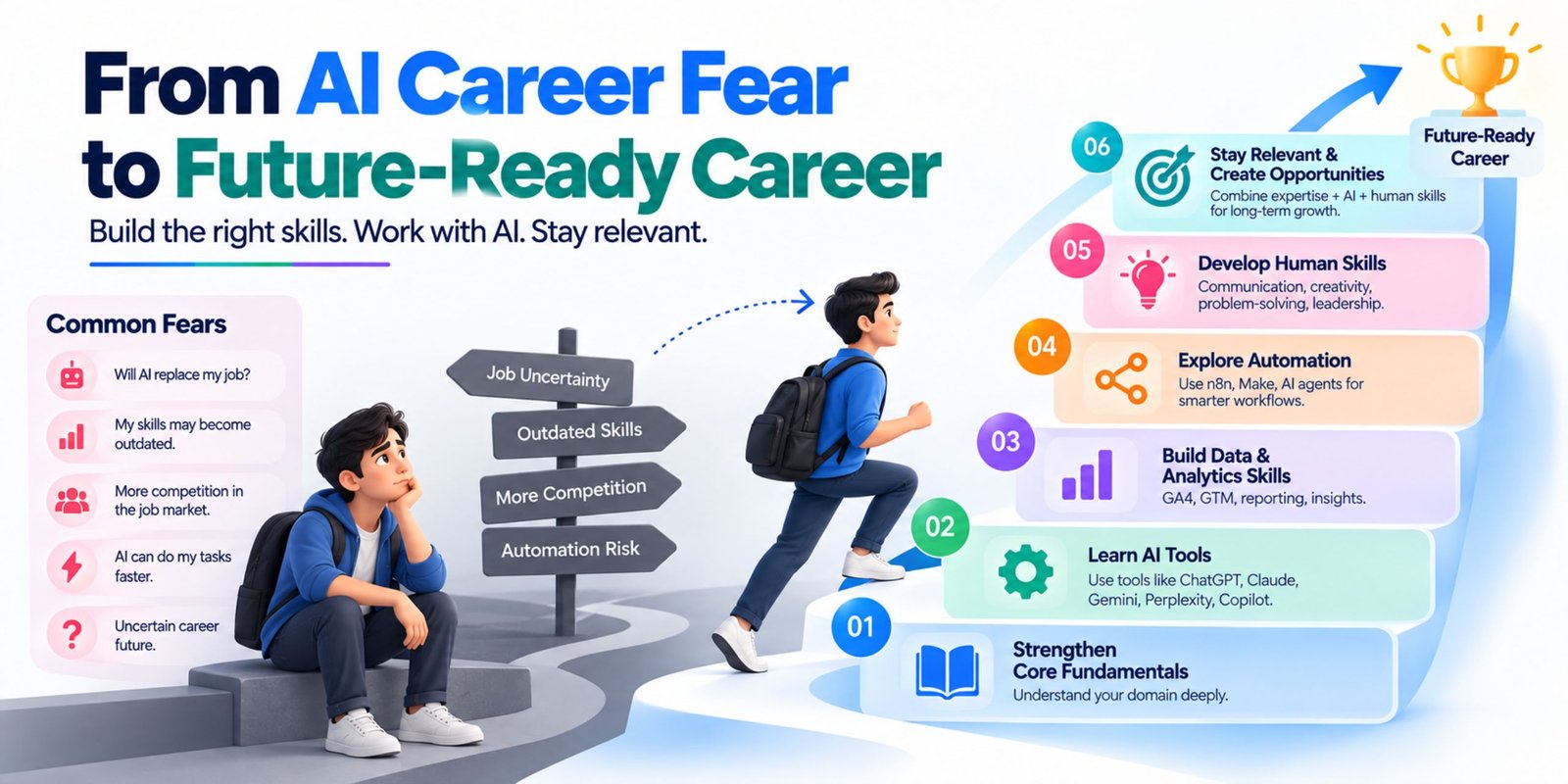
Students are worried that the skills they are learning today may become outdated tomorrow. Professionals are wondering whether AI will automate parts of their jobs. Fresh graduates are entering a job market where employers increasingly expect candidates to understand both their core profession and modern AI tools.
These concerns are understandable.
But there is an important distinction between a task being automated and an entire profession disappearing.
AI is increasingly capable of handling repetitive, structured, and predictable tasks. At the same time, businesses still need people who can understand customers, make decisions, solve problems, communicate ideas, manage projects, evaluate information, and take responsibility for outcomes.
The career question therefore shouldn’t simply be:
“Will AI replace my job?”
A more useful question is:
“Which parts of my work can AI improve, and which skills should I develop so I can work effectively with AI?”
For students and professionals, this shift in thinking can create a more practical approach to career development.
Why Are People Afraid of AI in the Workplace?
AI can perform tasks that previously required significant human time.
For example, AI tools can now assist with:
- Writing and editing
- Data analysis
- Research
- Image generation
- Video creation
- Coding
- Customer support
- Report preparation
- Workflow automation
- Document processing
This naturally creates uncertainty.
A professional who spends several hours preparing reports may wonder whether AI can automate that process.
A content writer may wonder whether generative AI can produce articles faster.
A digital marketer may wonder whether automated advertising systems will reduce the need for campaign management.
The important point is that task automation does not necessarily mean complete job automation.
A role often contains many different tasks, and AI may affect each of them differently.
AI Changes Tasks Before It Changes Careers
Consider a digital marketing executive.
The role may involve:
- Keyword research
- Content planning
- Ad copywriting
- Campaign setup
- Analytics
- Reporting
- Client communication
- Strategy
- Creative review
- Landing-page optimization
AI can assist with several of these activities.
For example:
ChatGPT can help generate content ideas and ad-copy variations.
Claude can assist with long-form analysis and strategy documents.
Gemini can support research and productivity workflows.
Perplexity can accelerate research and source discovery.
Microsoft Copilot can assist with spreadsheets, documents, and reports.
n8n and Make can automate repetitive workflows.
But the marketer still needs to determine:
- What the business objective is
- Who the target audience is
- Which campaign should be launched
- Which data is reliable
- What the results actually mean
- What should happen next
The value of the role can therefore shift from executing every individual task manually toward directing, evaluating, and improving AI-assisted workflows.
The Biggest Career Risk Is Not AI
For many professionals, the bigger risk is failing to adapt while the tools and workflows around them change.
Imagine two marketers.
Marketer A
Knows how to perform tasks manually but avoids learning new tools.
Marketer B
Understands marketing fundamentals and also knows how to use AI for research, content, analytics, automation, and productivity.
The second professional isn’t valuable simply because they know AI tools.
They are valuable because they can combine:
Marketing Knowledge + AI + Analytics + Human Judgment
That combination is much harder to replace than knowledge of a single repetitive task.
Skill 1: Build Strong Fundamentals
The first response to AI career fear should not be learning 50 AI tools.
It should be strengthening your core professional skills.
For digital marketers, this means understanding:
- SEO
- Search intent
- Paid advertising
- Conversion funnels
- Analytics
- Customer journeys
- Content strategy
- Branding
- Performance measurement
For finance professionals, it could mean:
- Financial analysis
- Business reporting
- Risk concepts
- Industry knowledge
For designers:
- Design principles
- Visual communication
- Branding
- User experience
AI becomes much more useful when you already understand the problem you’re trying to solve.
Skill 2: Learn How to Work With AI
Knowing how to open ChatGPT isn’t an AI skill.
Professional AI usage involves understanding:
- How to provide context
- How to structure prompts
- How to give examples
- How to evaluate outputs
- How to refine responses
- How to verify information
- How to integrate AI into workflows
For example, instead of asking ChatGPT:
“Write an ad.”
A performance marketer could provide:
- Target audience
- Product
- Offer
- Customer pain point
- Campaign objective
- Brand tone
- Platform
- Character limitations
The quality of the output improves because the marketer understands how to communicate the actual business problem.
This is why context and judgment remain important AI-era skills.
Skill 3: Develop Data and Analytics Skills
AI can generate recommendations, but marketers still need to understand the underlying data.
This makes analytics an important career skill.
Digital marketers should understand tools such as:
- Google Analytics 4
- Google Tag Manager
- Google Search Console
- Looker Studio
- Google Ads reporting
- Meta Ads reporting
You should be able to answer questions such as:
Where did the traffic come from?
Which campaign generated conversions?
Where are users dropping off?
What is the cost per acquisition?
Is the campaign generating qualified leads?
AI can help summarize reports, but you need enough analytical knowledge to determine whether the interpretation makes sense.
Skill 4: Learn Automation
One of the most practical ways to become more valuable in an AI-driven workplace is to understand automation.
Instead of manually performing the same task every day, identify whether the process can be automated.
For example:
Lead Form
↓
n8n / Make
↓
CRM
↓
AI Summary
↓
Sales Notification
↓
Follow-Up
Another example:
GA4 / Campaign Data
↓
Automation Workflow
↓
AI Analysis
↓
Weekly Report
This doesn’t mean automating everything.
The better approach is to identify repetitive processes where automation can reduce unnecessary manual work.
Skill 5: Learn AI-Powered Content Creation
Content creation is one of the areas most visibly affected by generative AI.
Tools such as ChatGPT, Claude, Gemini, and Microsoft Copilot can assist with:
- Blog outlines
- Social media posts
- Email drafts
- Ad copy
- Video scripts
- Content repurposing
- Research summaries
But AI-generated content still needs human direction.
A professional should review:
- Accuracy
- Originality
- Brand voice
- Audience relevance
- Search intent
- Factual claims
- Business objectives
The goal isn’t:
Human creates everything manually.
It also isn’t:
AI creates everything automatically.
The more useful model is:
Human Strategy → AI Assistance → Human Review → Final Output
Skill 6: Become Good at Asking Better Questions
As AI becomes more capable, the quality of the input becomes increasingly important.
Professionals should learn to ask:
- What problem are we solving?
- What information is missing?
- What assumptions are we making?
- What evidence supports this conclusion?
- What are the alternatives?
- What could go wrong?
- What should we test next?
These are not merely “prompt engineering” skills.
They are problem-solving skills.
A person who understands the problem deeply can usually use AI more effectively than someone who simply knows a collection of prompts.
Skill 7: Develop Human Skills AI Doesn’t Automatically Provide
Technology doesn’t eliminate the importance of communication.
Professionals still need:
- Critical thinking
- Communication
- Negotiation
- Leadership
- Collaboration
- Creativity
- Empathy
- Presentation skills
- Decision-making
Consider a client meeting.
AI can help prepare the presentation.
But someone still needs to understand the client’s concerns, ask the right questions, explain trade-offs, and take responsibility for the recommendation.
These skills become particularly important when situations are ambiguous.
AI Skills Should Be Combined With Domain Expertise
A common mistake is learning AI as a completely separate career skill.
Instead, combine AI with your existing profession.
For example:
Marketing + AI
AI-Powered Performance Marketing
SEO + AI
AI-Assisted SEO and GEO/AEO
Analytics + AI
AI-Powered Marketing Analytics
Design + AI
AI-Assisted Creative Production
Sales + AI
AI-Assisted Lead Qualification and CRM
Operations + AI
Workflow Automation and AI Agents
This creates a more specific professional advantage than simply describing yourself as someone who “knows AI.”
The AI Marketing Skill Stack
For someone building a career in digital marketing, a practical AI skill stack could look like this:
Foundation
- Digital marketing fundamentals
- Customer journey
- Marketing funnels
- Conversion principles
SEO
- Keyword research
- Search intent
- On-page SEO
- Technical SEO
- GEO
- AEO
Paid Media
- Google Ads
- Meta Ads
- LinkedIn Ads
- Creative testing
- Campaign optimization
Analytics
- GA4
- GTM
- Conversion tracking
- Reporting
- Attribution
AI Tools
- ChatGPT
- Claude
- Gemini
- Perplexity
- Microsoft Copilot
Automation
- n8n
- Make
- AI Agents
- CRM workflows
This is much more useful than learning AI tools randomly.
Don’t Try to Learn Every AI Tool
The AI ecosystem changes extremely quickly.
New tools appear constantly.
Trying to master every new platform can become a distraction.
Instead, choose tools based on your workflow.
For example:
Research → Perplexity
Content → ChatGPT / Claude
Google-oriented workflows → Gemini
Productivity → Copilot
Automation → n8n / Make
You can add other tools when they solve a genuine problem.
The objective is not to build the biggest tool collection.
It is to build the most useful skill stack for your career.
Build Projects, Not Just Certificates
One of the strongest ways for students to reduce career uncertainty is to create evidence of what they can actually do.
Instead of only completing courses, build projects such as:
SEO Project
Perform a website audit and create an SEO improvement plan.
Performance Marketing Project
Create a Google Ads or Meta Ads campaign structure and optimization plan.
Analytics Project
Set up a GA4/GTM measurement framework and create a marketing dashboard.
AI Content Project
Build an AI-assisted content workflow using ChatGPT, Claude, or Gemini.
Automation Project
Create an n8n or Make workflow connecting a lead form, CRM, spreadsheet, and notification system.
These projects demonstrate practical ability much more clearly than a list of AI tools on a resume.
How Students Can Stay Relevant
Students have one major advantage: they can build new skills before entering the workforce.
Instead of trying to become an expert in everything, build a structured learning path.
Start With Fundamentals
Learn marketing or your chosen professional field.
Add AI
Learn how AI tools can support that field.
Learn Analytics
Understand how to measure outcomes.
Build Projects
Create practical examples.
Develop Communication Skills
Practice explaining your work.
Build a Portfolio
Show what you can actually do.
This creates a stronger transition from education to employment.
How Professionals Can Stay Relevant
Professionals don’t necessarily need to restart their careers.
Start by auditing your current work.
Ask:
Which tasks take the most time?
Which tasks are repetitive?
Which tasks require judgment?
Which tasks could AI assist with?
Which skills should remain distinctly human?
Then experiment with AI in low-risk workflows.
For example, a marketer might start with:
Report summarization → AI-assisted analysis → Human verification
Then progress toward:
Campaign data → Automated workflow → AI-generated insights → Human decision
This gradual approach is more practical than trying to transform your entire job overnight.
How IILD’s Training Approach Can Help
For students and professionals entering digital marketing, learning AI in isolation is not enough.
IILD’s AI-powered digital marketing training can connect AI tools with practical marketing disciplines such as:
- SEO
- Google Ads
- Meta Ads
- Analytics
- Google Tag Manager
- Conversion tracking
- Content marketing
- Marketing automation
- AI workflows
- Performance marketing
Tools such as ChatGPT, Claude, Gemini, Perplexity, Microsoft Copilot, n8n, Make, and AI Agents can be integrated into actual marketing workflows.
The goal is to develop a professional who understands both how marketing works and how AI can improve the way marketing work gets done.
That combination is more useful than learning AI tools without understanding the business problems they are supposed to solve.
A Practical 90-Day AI Career Learning Plan
Days 1–30: Build Your Foundation
Focus on:
- Core professional skills
- AI fundamentals
- ChatGPT
- Claude
- Gemini
- Basic prompt design
- AI output verification
Build one small project.
Days 31–60: Add Technical Skills
For digital marketing, focus on:
- SEO
- Google Ads
- Meta Ads
- GA4
- GTM
- Conversion tracking
Use AI to assist with practical assignments.
Days 61–90: Build Workflows
Learn:
- n8n
- Make
- AI Agents
- Automated reporting
- Lead workflows
Then combine your skills into one complete project.
For example:
Research → Content → Campaign → Tracking → Analysis → Automation
This creates a portfolio project that demonstrates a complete workflow rather than an isolated AI skill.
The Future-Proof Mindset
There is no permanent list of “future-proof” tools.
A platform you learn today may change dramatically tomorrow.
What is more durable is the ability to:
Learn → Adapt → Experiment → Measure → Improve
If a new AI tool appears, you should be able to understand what problem it solves and determine whether it belongs in your workflow.
That is a more sustainable career skill than memorizing the features of a specific platform.
Conclusion
AI career fear shouldn’t be ignored—but it also shouldn’t become a reason to stop learning.
AI is changing how work gets done. Some tasks are becoming automated, some roles are changing, and new responsibilities are emerging around AI-assisted workflows.
For students and professionals, the practical response is to build a combination of:
Domain Expertise + AI Skills + Analytics + Automation + Human Skills
In digital marketing, that could mean learning SEO, Google Ads, Meta Ads, GA4, GTM, conversion tracking, AI content creation, marketing automation, and AI Agents, while using tools such as ChatGPT, Claude, Gemini, Perplexity, Copilot, n8n, and Make.
Don’t try to compete with AI at tasks AI performs efficiently.
Learn how to direct it, evaluate it, integrate it, and use it to solve better problems.
The career advantage isn’t simply knowing AI. It’s knowing how to combine AI with expertise to create measurable value.